
The Best Puppets for Play Therapy (and How to Use Them Clinically)
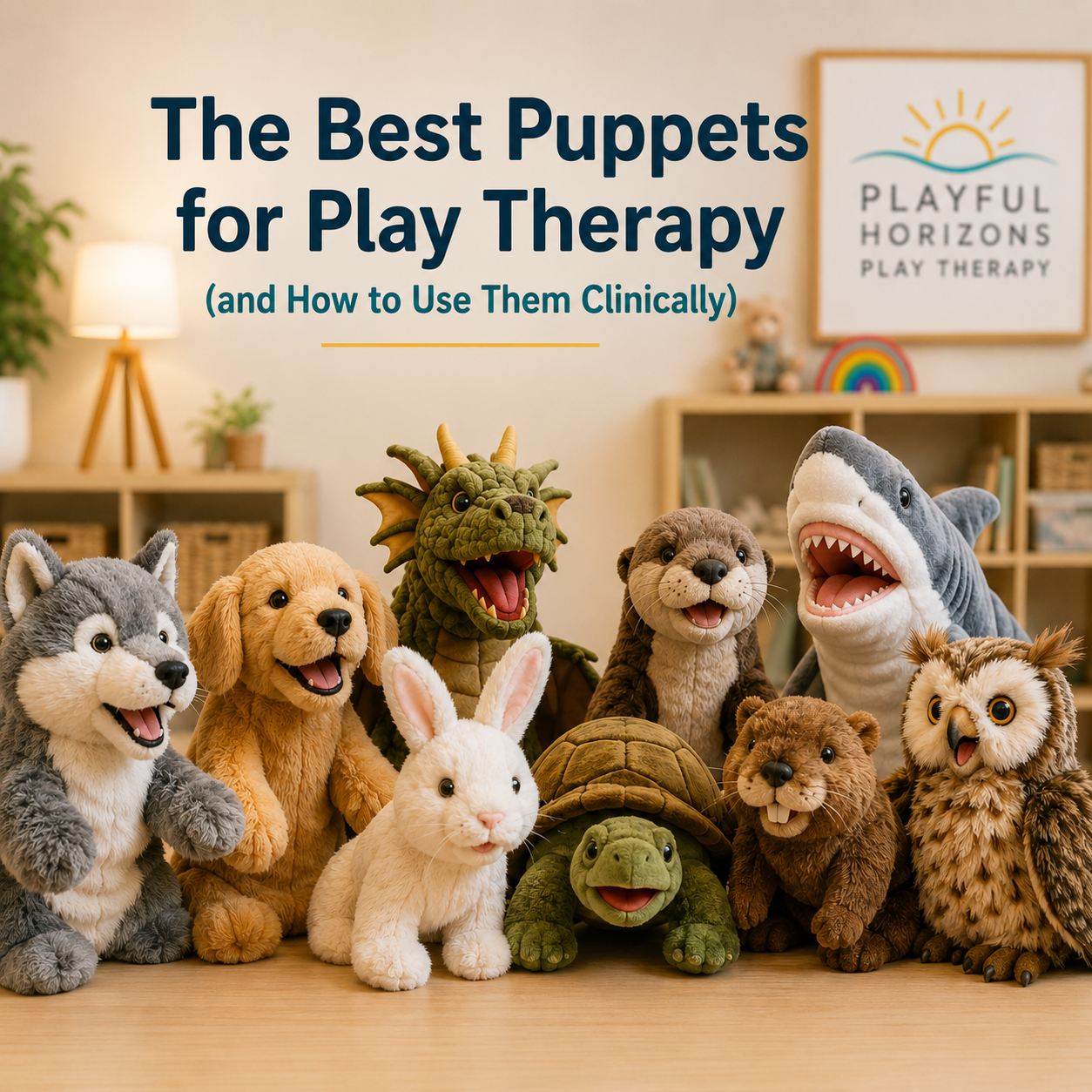
There is a particular kind of moment that happens in session when a child picks up a puppet, slips their hand inside, and suddenly starts saying things they could not say five minutes ago.
The puppet is talking now. Not them. That distance is exactly what makes them one of the most clinically rich tools we can keep in the therapy room.
This post breaks down why puppets work, what to look for when building your collection, and specific recommendations for puppets worth having on your shelf. (Click HERE to see the list)
Why Puppets Work: The Clinical Case
Puppets work because of something called projective distance. When a child voices a puppet, they can express feelings, fears, and needs that feel too big or too risky to own directly. The puppet becomes a container for what the child is not yet ready to claim.
This is not avoidance. It is developmentally appropriate processing.
Puppets also lower the relational stakes. Direct eye contact and direct questioning can feel threatening to anxious, traumatized, or avoidant children. Side-by-side puppet play gives the child something to focus on and a role to hide behind just enough to feel safe.
From a clinical standpoint, puppets support:
• Symbolic expression of emotions and experiences
• Externalization of internal conflicts
• Rehearsal of social situations and coping responses
• Narrative building and storytelling
• Attachment and relationship building with the therapist
• Building empathy and perspective-taking
What Makes a Good Therapy Puppet?
Not every cute stuffed animal belongs in a therapy room. When I am choosing puppets for clinical use, here is what I look for:
• A mouth that opens and closes. This is the single most important feature. A puppet a child can "talk" with feels alive in a way that flat or stiff puppets simply do not. It invites dialogue.
• Realistic enough to be taken seriously. Cartoony puppets can feel dismissive for older children or kids dealing with heavier content. Realistic animal puppets hold more emotional weight.
• A range of perceived emotional qualities. You want puppets that "feel" different … some soft and safe, some fierce and powerful, some small and vulnerable. The variety matters clinically.
• Durability. Therapy puppets get used hard. Quality construction means they hold up through hundreds of sessions.
• A mix of "safe" and "scary" animals. Children need both. Having a shark AND a bunny matters. Power, vulnerability, and everything in between.
Specific Puppets Worth Having in Your Therapy Room
The Folkmanis brand is my gold standard for therapy-quality puppets. They are realistic, beautifully made, and have the mouth articulation that makes them come alive in children's hands. Here are some of my top recommendations and the clinical reasons each one earns its place on the shelf.
Wolf or Husky Puppy
Dogs are often the first puppet children reach for. They feel familiar, loyal, and emotionally safe. A wolf or husky puppet bridges gentle and powerful in a single animal which makes it incredibly versatile for children who are working through both fear and the need for connection. Children who have experienced inconsistent caregiving are often drawn to dog puppets. They will nurture them, scold them, and love them in ways that tell you a great deal.
Turtle
The turtle is one of the most therapeutically rich puppets you can own. The shell is a built-in metaphor and children know it. Anxious kids and those who have learned to protect themselves through withdrawal understand the turtle on an instinctive level. Use the turtle to explore what it feels like to pull in, when it feels safe to come out, and what the world looks like from inside the shell. It is also a wonderful tool for introducing coping skills like the "Turtle Technique" for emotional regulation.
White Rabbit
Soft, small, and perceived as gentle, the rabbit tends to attract children who are scared, young at heart, or working through vulnerability. Rabbits feel "safe to protect." They are excellent for narrative play around themes of fear, being chased, or needing comfort. Children who themselves feel small or powerless will often project deeply onto a rabbit puppet.
Otter or Beaver
Playful, curious, and non-threatening, otters and beavers are wonderful for children who are resistant to therapy or still warming up to the relationship. Their energy is low-stakes and inviting. I often use these with kids who need some lightness in session before we can go deeper.
Alligator or Crocodile
This one surprises some therapists, but the alligator is one of the most important puppets in the room. Children who carry a lot of anger, who feel dangerous or out of control, or who have experienced aggression from others often gravitate toward the alligator. It holds power and threat in a contained, playful form. The alligator can be the bully, the scary parent, the part of themselves they are ashamed of or the protector they desperately wish they had.
Porcupine or Hedgehog
"Prickly on the outside, soft on the inside" is not just a cliche. It is a deeply felt experience for many of the children we work with. Children who present as reactive, defensive, or hard to connect with often have an immediate, instinctive reaction to the porcupine puppet. It gives them a way to name something true about their own experience without having to say it directly. This puppet opens conversations about self-protection, loneliness, and what happens when getting close feels dangerous.
Dragon
The dragon is magic for children who crave power, control, or a sense of being extraordinary. Kids who feel powerless, dismissed, or small tend to be deeply drawn to the dragon. It is fantasy, it is fierce, and it gives children a vehicle for potency and agency in their play. Dragons also work beautifully in trauma processing when children need to build a narrative of strength and survival. I particularly love the three-headed dragon which can represent thoughts, feelings, and behaviors in Cognitive Behavioral Therapy work.
Polar Bear
Bears are one of the most universally resonant animals across cultures and across developmental stages. A polar bear puppet carries both warmth and power, which makes it ideal for attachment work, nurturance themes, and parent-child relational play. Children who are working through loss, absence, or a longing for a protective figure are often drawn to bears.
Shark
Like the alligator, the shark often surprises therapists who think only in terms of "gentle" tools. But the shark is enormously valuable for children processing fear, threat, or big anger. It is the monster under the bed made tangible. Children can play out being scared of it, becoming it, defeating it, or even befriending it. Having a predator in the room gives children access to the full emotional spectrum.
Fox
Clever, quick, and often coded as a trickster in children's narratives, the fox is a wonderful puppet for children who are processing themes of trust, deception, or outsmarting a more powerful figure. It is also just appealing to a wide age range, which makes it a reliable go-to when you are not sure yet what a child needs.
Hippopotamus
The hippo is surprisingly underrated. Big, somewhat lumbering, with a mouth that opens wide. Children often use the hippo to play out themes of appetite, bigness, and taking up space. For children who have been told (directly or indirectly) that their emotions or needs are "too much," the hippo can become a powerful symbol of permission.
How to Actually Use Puppets in Session
You do not need a puppet script. You need a few basic approaches and the confidence to follow the child's lead.
• Let the child choose. Which puppet a child reaches for first tells you something. Notice it without commenting right away.
• Pick one up yourself. Parallel engagement with puppets (both of you using one) creates collaborative storytelling naturally. You don’t have to force it.
• Narrate and reflect through the puppet. "It seems like the shark is feeling really angry today." Tracking through the puppet keeps the projective distance intact while deepening the therapeutic work.
• Ask the puppet questions. "What does the turtle do when she feels scared?" Children will answer for their puppet in ways they cannot answer for themselves.
• Let the story go where it needs to go. Resist the urge to redirect toward resolution too quickly. The process of the play is the therapy.
Building Your Puppet Collection
You don’t need 30 puppets to get started. A carefully chosen set of 6 to 8 that covers the emotional range (small and vulnerable, big and powerful, fierce, gentle, clever, and protective) gives you a strong clinical foundation.
I have put together a curated list of my top puppet recommendations, all sourced from quality brands so you can build your collection easily.
[Explore the full curated puppet list here]
Some links may be affiliate links. I may earn a small commission at no extra cost to you.
You might also enjoy:
• How Play Therapy Helps Children with Anxiety
• The Ultimate Slime Supplies List for Therapists
• The Ultimate Play Therapy Supply Lists
Have a puppet you love using in sessions? Drop it in the comments … I would love to hear what is working in your room.