
The Best Sensory School and Office Supplies for Therapists
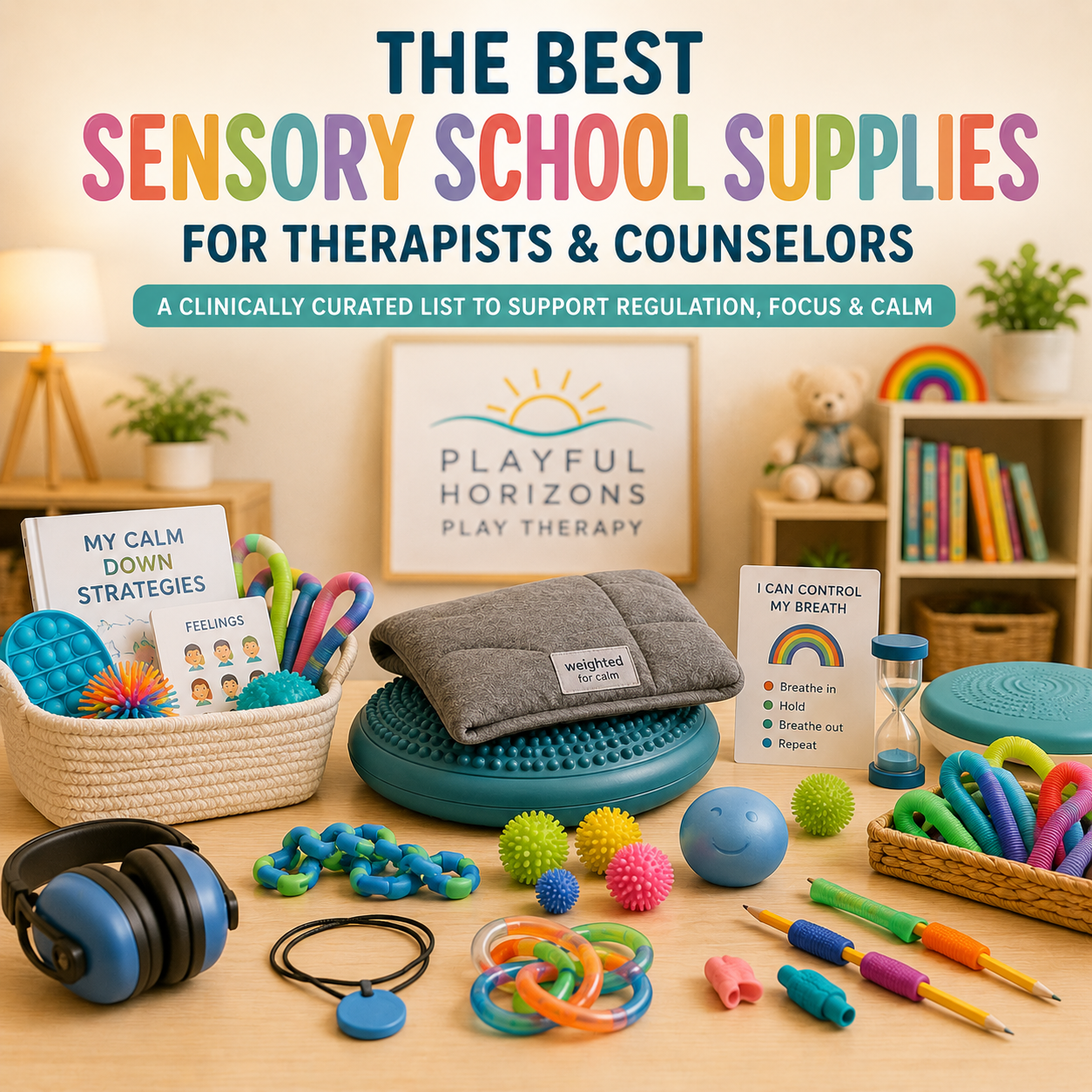
Walk into a well-stocked therapy room or school counseling office and you will feel it immediately. Something about the space says: you can slow down here. You are safe here. There is room for you here.
That feeling does not happen by accident. It is built, intentionally, through the tools, textures, and sensory elements we choose to put in our spaces.
Sensory supplies are not decorative extras. They are clinical tools. The right fidget in the right moment can help a dysregulated child settle enough to actually access the session. A weighted lap pad in a school counseling office can help an anxious student focus enough to talk. A wobble cushion can give a child with ADHD just enough proprioceptive input to stay in their seat and stay present.
Over the years I have spent a lot of time curating what actually belongs in a therapy room and school counseling office, and a lot of time weeding out what looks great on a shelf but does not hold up clinically. This post walks through the categories of sensory supplies worth having, the clinical reasoning behind each one, and the specific items I recommend. I have pulled everything together into one easy-to-shop list on my Amazon storefront so you can build your collection without the hours of scrolling.
Why Sensory Supplies Matter Clinically
Before we get into specifics, it is worth taking a moment to ground this in the neuroscience, because when we understand why sensory tools work, we use them with so much more intention.
Children regulate their nervous systems through sensory input long before they can do it verbally or cognitively. Proprioception (the sensation of pressure and movement in the body), vestibular input (balance and spatial orientation), and tactile stimulation are all bottom-up regulation pathways. They work directly on the nervous system without requiring the child to think, reflect, or articulate anything.
This is exactly why a child who has been dysregulated by something at school can walk into a therapy room, pick up a fidget tool, and slowly come back online. The sensory input did the work before any words were spoken.
For therapists working in schools, this matters even more. School counselors and school-based clinicians often see children in brief windows, sometimes just 15 to 30 minutes, often right after something hard has happened. Sensory tools give you a way to help a child regulate quickly so that the limited time you have is actually productive.
The Categories Worth Stocking
Fidgets and Tactile Tools
Fidget tools are one of the most misunderstood and misused sensory tools in existence. Used poorly, they become a distraction. Used well, they are a regulation lifeline.
The key is matching the fidget to the child's sensory need. A child who needs calming input needs something smooth and repetitive, like a silicone ring or a smooth stone. A child who needs alerting input (think ADHD, low arousal) does better with something textured, clicking, or more complex.
I look for fidgets that are quiet enough for school settings, durable enough for repeated clinical use, and varied enough to offer options across sensory profiles. Having a small tray or basket of 4 to 6 different options and letting the child choose is a simple but powerful way to build interoceptive awareness over time.
Weighted Tools
Deep pressure and weight are among the most reliably calming sensory inputs we have. The proprioceptive input from a weighted lap pad, a weighted shoulder wrap, or even a heavy blanket across the legs activates the parasympathetic nervous system in a way that promotes calm, focus, and groundedness.
Weighted lap pads are especially practical for school settings because they are discreet, easy to use at a desk or on the floor, and do not require the child to leave the space. A child can use one during a counseling session, during a check-in, or during a group activity without it looking different from anything else.
A general guideline is to use a weight of approximately 10 percent of the child's body weight, though this should always be considered in the context of the individual child's sensory profile and any relevant medical considerations.
Movement and Seating Tools
Children need to move. This is not a behavioral problem. It is a neurological reality. Children who are forced to sit completely still are often spending so much cognitive energy managing their bodies that they have little left over for anything else.
Wobble cushions and inflatable seat discs give children a sanctioned way to move while remaining in their seat. The subtle vestibular and proprioceptive input they provide is alerting and organizing for children who need more movement input to stay regulated.
For therapy offices, a small exercise ball or scoop rocker can serve a similar purpose during sessions. Some children simply cannot process and talk effectively while sitting still, and giving them something to gently move on changes the session entirely.
Calm Down Corner Supplies
A calm down corner is one of the most valuable things a school counselor or school-based therapist can build. It is a designated space, usually small, that communicates safety and gives children a concrete place to go when their nervous system is overwhelmed.
The supplies that make a calm down corner effective are sensory ones: a soft textured pillow, a visual feelings chart, a glitter jar or calm-down bottle, a small selection of fidgets, and something grounding and tactile to touch. The corner should feel physically different from the rest of the space, quieter, softer, and lower to the ground.
In a private practice therapy room, the equivalent might be a dedicated cozy corner with a floor cushion and a small basket of calming tools. The clinical message is the same: this is a space where your nervous system is welcome.
Sensory Writing and Fine Motor Tools
This is a category that gets overlooked in favor of more obviously "sensory" items, but the tools a child uses to write, draw, and create during sessions are part of the sensory environment too.
Pencil grips, textured pens, and weighted writing tools all provide tactile and proprioceptive input that can help a child stay regulated and focused during seated activities. For children with ADHD or sensory processing differences, the right writing tool makes a noticeable difference in their ability to stay on task.
These tools also double as subtle, desk-appropriate fidgets. A child who is quietly running their thumb along a textured pen grip during a lesson or session is regulating, not misbehaving.
A Note About Curating Your Collection
You do not need to buy everything at once. Building a sensory toolkit is something that happens gradually, and the most important thing early on is variety: a few items that calm, a few that alert, a few that provide tactile input, and a few that support movement.
Pay attention to what children reach for repeatedly. That pattern tells you what their nervous systems are looking for, and it can guide both what you add to your collection and how you think about their regulatory needs more broadly.
The other thing worth knowing: quality matters more than quantity. A well-made sensory tool that holds up through hundreds of sessions is far more valuable than a cheap one that breaks in two weeks. I have made that mistake enough times to be firm about it now.
Shop the Full Sensory Supplies List
I have pulled together everything I recommend into one curated Amazon list: fidgets, weighted tools, calm down corner supplies, movement tools, and sensory writing tools, all vetted for clinical use and quality.
Whether you are setting up a therapy room for the first time, refreshing a school counseling office, or looking for a few targeted tools to support specific kids on your caseload, this list is a good place to start.
[Shop the Sensory School and Office Supplies List on Amazon]
Some links may be affiliate links. I may earn a small commission at no extra cost to you. I only recommend products I actually use and believe in.
You might also enjoy:
• 5 Ways to Use Wax Craft Sticks in Play Therapy Sessions
• The Ultimate Slime Supplies List for Therapists
• The Best Puppets for Play Therapy (and How to Use Them)
• How Play Therapy Helps Children with Anxiety
Have a sensory tool you swear by that is not on the list? Drop it in the comments. I am always looking for what is working in other therapists' rooms.