
5 Ways to Use Wax Craft Sticks in Play Therapy Sessions
Wax craft sticks are a surprisingly powerful tool in the play therapy room. Bendable, mess-free, and endlessly moldable, these colorful sticks support fine motor development, emotional expression, body mapping, symbolic play, and nervous system regulation, all without glue, scissors, or cleanup. Here are five clinically grounded ways to use them in session.
* Blog may contain some affiliate links. That means I may earn a small commission (at no extra cost to you) if you choose to buy through them. I only share items I love, trust, or use in my own play spaces.
Some of the best therapy tools are the ones that do not look like therapy tools at all.
Wax craft sticks are exactly that. The moment a child spots them on the table, they reach for them. There is no hesitation, no wariness, no "what are we doing today." They just start making things.
Wax craft sticks are made from yarn coated in wax, which means they bend, twist, mold, and stick to each other and most surfaces without glue, scissors, or any mess. They are non-toxic, reusable, and come in a range of colors and lengths that make them incredibly flexible for therapeutic use. The set I recommend and keep in my own therapy room is the Purple Ladybug 300-piece pack, with 15 bright colors in both 6-inch and 12-inch lengths, which gives you enough variety to work creatively across sessions without running out.
Here are five ways I use them in session, and the clinical reasoning behind each one.
1. Body Mapping and Somatic Awareness
Children who experience anxiety, trauma, or big emotions often carry those experiences in their bodies long before they can name them verbally. Body mapping gives them a concrete, visual way to locate and explore what they are feeling somatically.
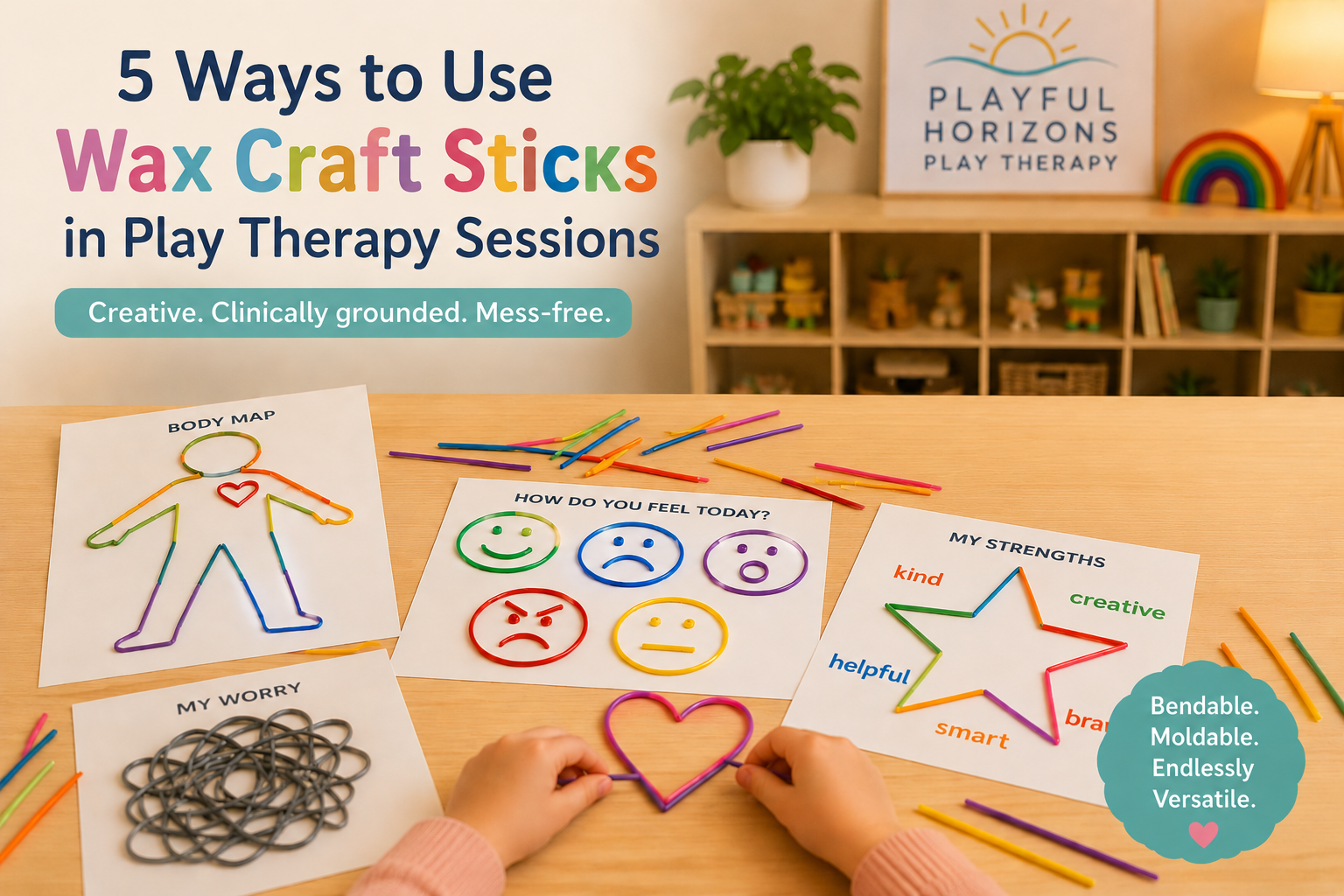
Print or draw a simple outline of a body (you can find free templates online or draw one together at the start of session). Ask the child to choose a color that matches how each part of their body feels right now, then use the wax sticks to fill in or outline those areas on the figure.
The moldable quality of wax sticks makes this especially effective. A child who feels tightness in their chest might press a stick firmly and make it look hard and angular. A child who feels numb might barely press at all, leaving a loose, light outline. The pressure and the shape communicate what words often cannot.
This works beautifully as a check-in intervention at the start of sessions and can be revisited over time to track how a child's felt sense of their body shifts across the course of treatment.
2. Feeling Faces and Emotion Sculpting
Building emotional vocabulary is one of the core tasks of play therapy, and wax craft sticks offer a hands-on, three-dimensional way to do exactly that.
Invite the child to create a "feeling face" using the sticks, bending and arranging them to show an emotion. You can make it playful and collaborative: each of you makes a face, and you try to guess what the other is feeling. Or make it more directive: "Can you make a face that shows what you feel when you walk into school?"
What children build often goes well beyond the basic happy/sad binary. A child might make a face with a smile and a furrowed brow and call it "pretending to be okay." Another might build something asymmetrical and say "I do not know what it is called but it feels like this." Both are incredible therapeutic moments.
Older children and adolescents who might resist more overtly childlike interventions are often surprisingly willing to engage with this one because the wax sticks feel like an art medium, not a therapy worksheet.
3. Worry Shapes and Externalizing Anxiety
Anxious children often describe their worry as a vague, formless "everywhere" feeling. Externalizing interventions work because they help children locate the worry outside of themselves and give it a form they can look at, talk to, and eventually feel some power over.
Ask the child to build their worry using the wax sticks. What color is it? What shape? How big? Does it have sharp edges or soft ones? Is it heavy or light?
Children take this seriously. The worry often becomes a named, specific thing: a tangled gray knot, a spiky red shape, a thick dark coil. And once it has a form, you can work with it clinically. You can ask what the worry is trying to protect. You can build a "calm" shape alongside it. You can shrink the worry shape session by session as the child builds coping skills.
The fact that wax sticks are reusable is a quiet therapeutic advantage here. The child can reshape the worry, dismantle it, or transform it into something else entirely, which is its own kind of symbolic mastery.
4. Strengths Mapping and Coping Toolkits
Strengths-based work is most effective when it is experiential rather than verbal. Telling a child they are brave lands very differently than inviting them to build what bravery looks like.
Use wax sticks to create a visual strengths map. Each stick or shape can represent something the child does well, a person in their life who supports them, a coping strategy that helps, or a quality they are proud of. The longer 12-inch sticks are great for this because they feel more substantial and give children more to work with.
You can also build a "calm down toolkit" together using the sticks. Each stick represents one strategy: a deep breath, a grounding tool, calling a trusted person, a safe place in their imagination. The child arranges them however makes sense to them, fanned out, stacked, or woven together.
What makes this intervention stick is that children made it themselves. It is not a printable someone handed them. It came from their hands and their choices, which makes it far more likely to be truly internalized.
Some children will want to keep what they built. Consider having a small box or envelope where they can store their wax stick creations and bring them back to future sessions.
5. Free Sculpting and Projective Play
Sometimes the most powerful clinical intervention is the one with the least structure. You can make them part of your Child Centered Play Therapy room or set them out and say nothing more than "see what you can make." Then watch.
What a child creates in open-ended, unstructured time with a tactile medium is often incredibly revealing. Do they make something neat and precise? Do they layer colors carefully or grab randomly? Do they make something recognizable or something abstract? Do they show you or keep it private?
The self-sticking quality of wax craft sticks makes them especially good for spontaneous 3D construction. Children can build figures, animals, letters, structures, and scenes that would not be possible with a flat drawing medium. A child might build a house, then quietly press every door shut. Another might build a person with arms reaching out. The symbolism tends to emerge on its own without prompting.
Your role in this intervention is to stay curious, reflect what you notice without over-interpreting, and follow the child's lead. "Tell me about what you made" is often all you need to open the conversation.
This kind of projective play is where child-centered play therapy does some of its deepest work, and wax sticks are a low-barrier, high-engagement medium that invites children into it naturally.
Why Wax Craft Sticks Belong in Your Therapy Room
Part of what makes wax craft sticks such a strong clinical tool is that they work across a huge range of ages, presenting concerns, and theoretical orientations. They are sensory without being overwhelming, creative without requiring artistic skill, and open-ended enough to follow a child wherever they need to go.
They support:
• Fine motor development and sensory regulation
• Somatic and emotional awareness
• Externalizing and symbolic expression
• Narrative building and projective play
• Strengths-based and coping skill work
They are also mess-free, affordable, and reusable, which matters when you are stocking a busy therapy room on a real-world budget.
The set I recommend is the Purple Ladybug 300-piece Bendable Wax Craft Sticks: 15 colors, two lengths, non-toxic, and genuinely excellent quality for repeated clinical use.
[Shop Purple Ladybug Wax Craft Sticks on Amazon]
This is an affiliate link. I may earn a small commission at no extra cost to you. I only recommend products I actually use and believe in.
You might also enjoy:
• The Ultimate Slime Supplies List for Therapists
• The Best Puppets for Play Therapy (and How to Use Them)
• How Play Therapy Helps Children with Anxiety
• The Ultimate Play Therapy Supply Lists
Have a way you use wax craft sticks in session that I did not cover? Drop it in the comments. I always love hearing what is working in other therapists' rooms.