
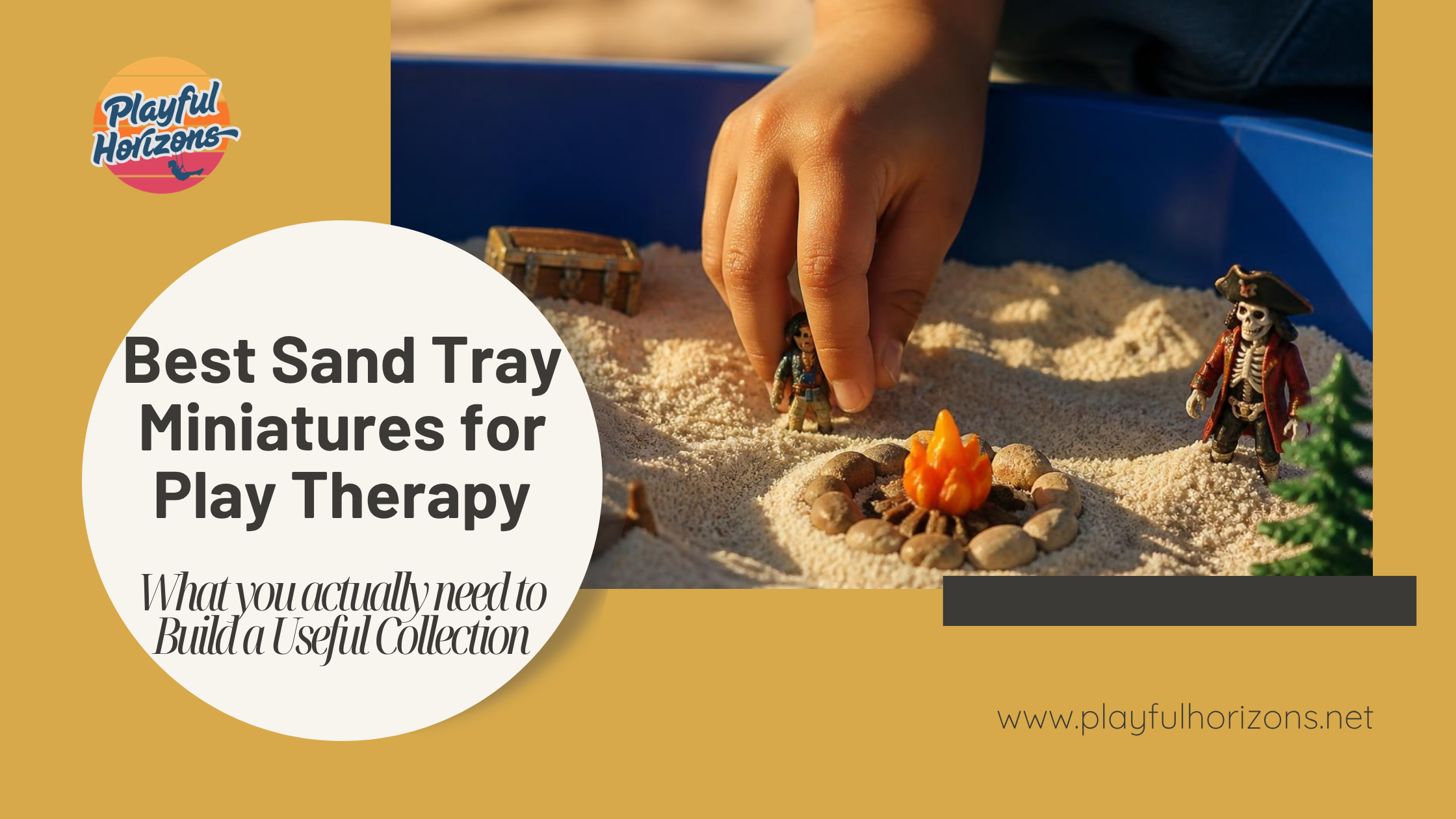
Best Sand Tray Miniatures for Play Therapy: What You Actually Need to Build a Useful Collection
* Blog may contain some affiliate links. That means I may earn a small commission (at no extra cost to you) if you choose to buy through them. I only share items I love, trust, or use in my own play spaces.
You start with a random handful of miniatures that you found at the thrift store or maybe even stole from your kids room. Then you order a starter set. Then you find yourself standing in the Target dollar section evaluating whether a two-inch toaster shaped eraser has therapeutic potential. No joke, that’s a real thing that happened to me. (Spoiler alert, I did buy the toaster. I couldn’t help myself, ha!)
Collecting miniatures can become a genuine obsession for a lot of play therapists and I am absolutely not exempt. I've hunted through thrift stores and yard sales, ordered tiny things off Etsy at midnight, found gems at aquarium supply stores (don’t sleep on those for incredible bridges and treasure chests!) and cake decorating shops, and yes even inherited a solid portion of my collection from my own kids when they outgrew their toys. I still find miniatures on vacation, when I pop into a random store, and occasionally when my kids are purging their rooms.
The collecting is actually really fun. However, the fun of finding something tiny and interesting is not the same thing as knowing whether it belongs in your collection which is really important. A strong sandtray collection is not defined by quantity. It is defined by symbolic possibility and whether a client of any age, background, or presenting concern can walk up to your shelves and find something that can represent their world. That's the goal we’re building toward.
What Makes a Good Sand Tray Miniature?
Before we get into specific categories, it helps to know what you're actually looking for when you're evaluating whether something belongs in your collection.
• Durable: These figures are buried, dropped, and moved constantly. Cheap pieces that chip or break don't belong in a therapeutic space. Neither do deeply sentimental or fragile pieces that you would be upset if they got broken.
• Proportionally workable: Not everything needs to be the same size, but pieces shouldn't be so mismatched that they become confusing. We want them to generally be exactly as the name implies, miniature, with some exceptions.
• Emotionally varied: Your collection needs to hold gentleness and ferocity, safety and danger, power and vulnerability. Whatever feeling your kiddo is experiencing … there should be something to represent it.
• Culturally and developmentally diverse: Your clients are not all the same and your collection shouldn’t be either. Make sure your clients can find themselves in it.
• Not all prescriptive: A figure that can only ever be one thing limits what a client can do with it. Some ambiguity is actually an asset, so include a few abstract pieces as well.
That last point is worth thinking about a bit. A figure doesn't always need to tell the therapist exactly what it is. I've had a child use a beer bottle as a soda bottle. I've seen a marijuana leaf placed as a bush in front of a house. A client who uses a figure "wrong" is often using it exactly right for their story. We follow their lead to understand the world that’s been created in the tray.
Also worth saying and I honestly didn’t think I ever would BUT you can have too many miniatures. If a child walks up to the shelves and doesn't know where to begin or the sheer volume overwhelms rather than invites, you've gone past useful. You want enough for full symbolic range, but not so much that the shelves become too noisy.
How Many Do You Actually Need?
There's no magic number, but a collection of 150 to 300 well-chosen pieces with strong category representation is a great goal for a primary therapy space. A functional starter collection, enough to actually begin using sandtray while you build over time, can work at 60 to 100 pieces if the categories are covered.
I started with a small pre-made starter set from one of the major play therapy supply companies which was a good jumping-off point, but I quickly felt the gaps. Certain categories were missing entirely. The representation was limited. You feel those gaps in session before you can fully name them … a client looking for something you don't have or settling for "something close." That feeling is the signal to expand.
For a portable setup, it’s a bit more flexible and the priorities shift. If that's your situation right now, I've written separately about building a portable play therapy kit that includes sandtray recommendations for traveling therapists or just therapists with very limited space. [Ultimate Portable Play Therapy Supply Lists]
The 12 Core Miniature Categories
This framework is adapted from Homeyer and Sweeney's Sandtray Therapy: A Practical Manual which is one of the foundational sandtray references I recommend to anyone building this modality. These 12 categories represent the full symbolic landscape a collection should be able to cover. I've also created a free Miniature Categories Poster based on this framework that you can keep near your shelves as a reference.
[Coming Soon: Shop my full curated Sandtray Miniatures Amazon List]
1. People
Family groups, brides and grooms, occupational figures (helpers, judges, doctors), hobbies, sports, stage-of-life figures (babies, elderly, graduates, etc.), historical figures.
This is where representation matters most. Your people figures should reflect real diversity in skin tone, age, ability, family configuration, and cultural background. A child should be able to find themselves, their family members, and the important people in their world.
Prioritize this category based on your population. Younger children often use animals or objects to represent people rather than actual people figures, so don't overbuy here if you work primarily with very young kids. Older children, teens, and adults reach for people figures much more directly.
I've written separately about three specific figures that children repeatedly choose when representing parents in the sand tray and the patterns that come up across hundreds of sessions are both fascinating and sometimes heartbreaking. [The Top 3 Miniatures Kids Use to Represent Parents in the Sand Tray]
[Coming Soon: Shop people miniatures]
2. Animals
Prehistoric (dinosaurs are always a hit), zoo and wild animals, farm and domestic animals, birds, insects, sea life.
Animals are one of the most-used categories across all ages and especially with younger children who tend to use them to represent people rather than using people figures directly. A dinosaur might be a scary parent. A mama bear might be the client. A snake might be the thing they're most afraid of. Don't make assumptions, just follow their lead.
One specific note: if you work with middle school girls, get horses. A lot of them. This is not an exaggeration. They will reach for them constantly.
[Coming Soon: Shop animal miniatures]
3. Buildings
Houses and apartments, schools, hospitals, courthouses, jails, churches and temples, castles, forts, barns.
Buildings create the scaffolding of a client's world including where people live, where they go, what structures hold or confine them. A hospital might represent healing or fear. A jail might be about punishment or, for some kids, safety. The building itself doesn't tell you what it means. The story around it does.
[Coming Soon: Shop building miniatures]
4. Transportation
Cars (family, police, taxi), trucks (military, farm, emergency vehicles), flight vehicles, nautical (boats especially), motorcycles, bicycles, trains.
Transportation is one of the most important categories for younger children and one of the most commonly underprioritized. Vehicles represent movement, escape, arrival, power, emergency … all things that show up constantly in children's play. A police car means something very different to different kids. This is a category worth stocking early and generously if you see young children.
[Coming soon: Shop transportation miniatures]
5. Vegetation
Trees (with and without leaves, palm trees, pine trees, Christmas trees), bushes, flowers, hedges, cacti.
Vegetation creates environment and atmosphere. A bare tree and a full leafy tree say different things about a scene. These pieces might seem like background decoration, but they're doing real symbolic work in the emotional landscape of a tray.
[Coming soon: Shop vegetation miniatures]
6. Fences, Gates, and Signs
Fences of all types (enough to fence the full perimeter of a tray), gates, barricades, traffic and street signs, railroad tracks.
This category is about boundaries both literally and symbolically. A client who surrounds certain figures with a fence is communicating something. A gate that opens is different from a barricade that doesn't. Having enough to actually enclose a space matters more here than having huge variety at least to begin with.
[Coming soon: Shop fences and gates]
7. Natural Items
Seashells, dried seeds and flowers, twigs, rocks, minerals, crystals.
Natural items carry a different energy than manufactured figures. They’re grounding, organic, and often deeply calming to handle. Some clients gravitate toward them precisely because they feel less loaded than a human figure or weapon. This is also a category where creative sourcing really pays off. Aquarium stores, craft stores, and the natural world itself are all excellent sources. Most of mine didn't come from a play therapy catalog.
[Coming soon: Shop natural items]
8. Fantasy
Wizards, fairy godmothers, wishing wells, magical creatures, monsters, folklore figures, ghosts, gnomes, skeletons.
Fantasy figures give clients access to things that realistic figures simply can't hold. Magic and monsters can carry what ordinary life can't quite contain. A dragon can be protection or terror. A skeleton can hold death, loss, or fear in a form that feels more approachable than a realistic representation. Teens and adults often gravitate toward this category more than you'd expect as symbolic expression tends to increase with emotional sophistication.
[Coming soon: Shop fantasy miniatures]
9. Spiritual and Mystical
Western and Eastern religious symbols, other religious groups, crystal balls, mirrors, pyramids, and other mystical objects.
This is a category newer therapists often skip and I'd really encourage you not to. Spiritual and religious figures get used more than people expect and they hold enormous meaning. Faith, doubt, protection, ritual, belonging … all of it can live here. Make sure your collection represents more than one tradition. A client whose spiritual life doesn't look like Western Christianity should still be able to find something that resonates.
[Coming soon: Shop spiritual and mystical miniatures]
10. Household
Furniture, tools, containers (bowls, cups, baskets, boxes), dishes, food, electronics.
Household items help clients build the interior life of their scenes like what happens inside their world or what daily life looks like. A table set for a meal means something. An empty room means something else. These details and scenes often carry the emotional context of a client's experience more than any single figure could.
[Coming soon: Shop household miniatures]
11. Landscaping and Other
Sky and celestial objects (sun, moon, rainbow), topographical features (mountains, tunnels, volcano, fire), bridges, monuments, treasure chests.
These pieces set the larger environment and emotional tone of a tray. A rainbow and a storm cloud say different things. A bridge might represent transition or connection. A volcano can hold erupting emotion. Celestial items in particular (sun, moon, stars) get used across all ages and often carry a lot of weight in the overall feeling of a scene. These are pieces I see used equally for symbolic or literal meanings.
[Coming soon: Shop landscaping miniatures]
12. Miscellaneous
Medical items (face masks, pill bottles), drug and alcohol items (wine bottles, beer cans, marijuana leaf), weapons, and other charged objects. Anything else that makes sense for your population.
This is the category most therapists hesitate over. I want to address that directly, because I think the hesitation costs some clients something real.
The kids and teens who need these items, who need to see a beer bottle or a pill bottle or a weapon on your shelf to know that their world is welcome here … really need them. Their presence communicates acceptance. They say: you can show me what your life actually looks like. You don't have to make it cleaner or safer than it is to be in this room.
The kids who don't need them typically don't engage with them at all or use them as something completely different. I've had children use beer bottles as soda bottles and a marijuana leaf as a bush in a front yard. You are not planting ideas by having these things on your shelf. You are creating space for children whose real lives include these things to finally show you.
And as always, don't assume you know what something means. Follow the client's lead. The miniature you think you understand might be doing something entirely different in the kiddo’s world.
[Coming soon: Shop miscellaneous miniatures]
Where to Actually Find Good Miniatures
Play therapy supply companies are a great starting point, especially for people figures and really specific items or just to grab a good starter kit, but some of the best pieces in my collection didn't come from a catalog. You can literally find miniatures almost anywhere from kids meals to outdoor nature hikes and pretty much anywhere in between. Here are a few of my favorite places to consistently find good miniatures:
• Thrift stores and yard sales: endlessly useful, especially for vehicles, household items, and natural objects. Budget-friendly and genuinely surprising. I really love digging through the little bins of toys and seeing what I can find. It’s like a treasure hunt!
• Etsy: excellent for unique, handmade, or culturally specific figures that mainstream suppliers don't carry. These are the miniatures that can evoke big feelings even through the screen. I could seriously scroll through Etsy miniatures for hours.
• Aquarium supply stores: incredible for natural items, shells, and small decorative pieces that work beautifully in trays. Don’t sleep on the fish tank decor either. My best bridges and treasure chests have come from fish stores.
• Cake decorating stores and sites: tiny, high-detail figures that are perfectly proportioned for sandtray work. These are especially useful for stage of life miniatures at a great price point.
• Craft stores: especially the seasonal sections. Holiday displays consistently turn up useful miniatures and are often on sale once the holiday is over. I have found really cool ornaments or key chains here that I take the rings or hooks off on and use as miniatures.
• Your own kids' toy bins: once they're done with something, it may have a whole second life in a sand tray. I’m not going to lie, I have chosen gifts for them based on things I want in my sand tray room later because I know eventually they’ll be ready to pass it along, lol. If you don’t have kiddos, ask your friends who do. I can guarantee they’d love to get rid of a bunch of those little toys and pass them along for a good cause!
The one thing to keep in mind as you find pieces out in the world is, does it fit? Does it fill a gap in your collection, add meaningful representation, or expand symbolic range? The fun of finding something tiny and interesting and the clinical purpose of having it on your shelf are two different things. Both matter, but only one is the reason to add it to the collection.
Shop the Full Sandtray Miniature List
If you’re feeling a little overwhelmed and want one place to start, I'm pulling my favorite picks across all 12 categories into one curated Amazon list which is organized by category, focused on quality and value, and built around symbolic range rather than quantity. Come back here to see the full list once it’s complete!
[Coming soon: Shop the Full Sandtray Miniature Collection on Amazon]
Some links in this post are affiliate links. I may earn a small commission at no extra cost to you. I only recommend pieces I'd actually put in my own collection.
You might also enjoy:
• The Top 3 Miniatures Kids Use to Represent Parents in the Sand Tray
• Play Themes in Child-Centered Play Therapy: What Should You Actually Pay Attention To?
• How to Set Up a Child-Centered Play Therapy Room: What You Actually Need
• Ultimate Portable Play Therapy Supply Lists
What's the most unexpected place you've ever found a miniature? I'd love to hear it in the comments.