
How to Set Up a Child-Centered Play Therapy Room: What You Actually Need (and What You Don't)
Make it stand out
* Blog may contain some affiliate links. That means I may earn a small commission (at no extra cost to you) if you choose to buy through them. I only share items I love, trust, or use in my own play spaces.
Not long ago I walked into a therapy space that a newer clinician had been building out on her own. She had clearly put real effort into it. There were toys everywhere. Puppets covering an entire shelf (probably 20 or more!). A whole corner packed with dress-up clothes. Art supplies in various states of dryness, some broken, some barely functional. Stuffed animals. Random games. Bins overflowing.
After we worked through the space together, cleaned it out, organized what stayed, and set it up following child-centered play therapy recommendations, one of her young clients walked in for the next session.
The child walked to the middle of the room, stopped, and took a breath. An actual, audible sigh of relief. And then said: "This feels so much better."
Kids notice. They notice everything.
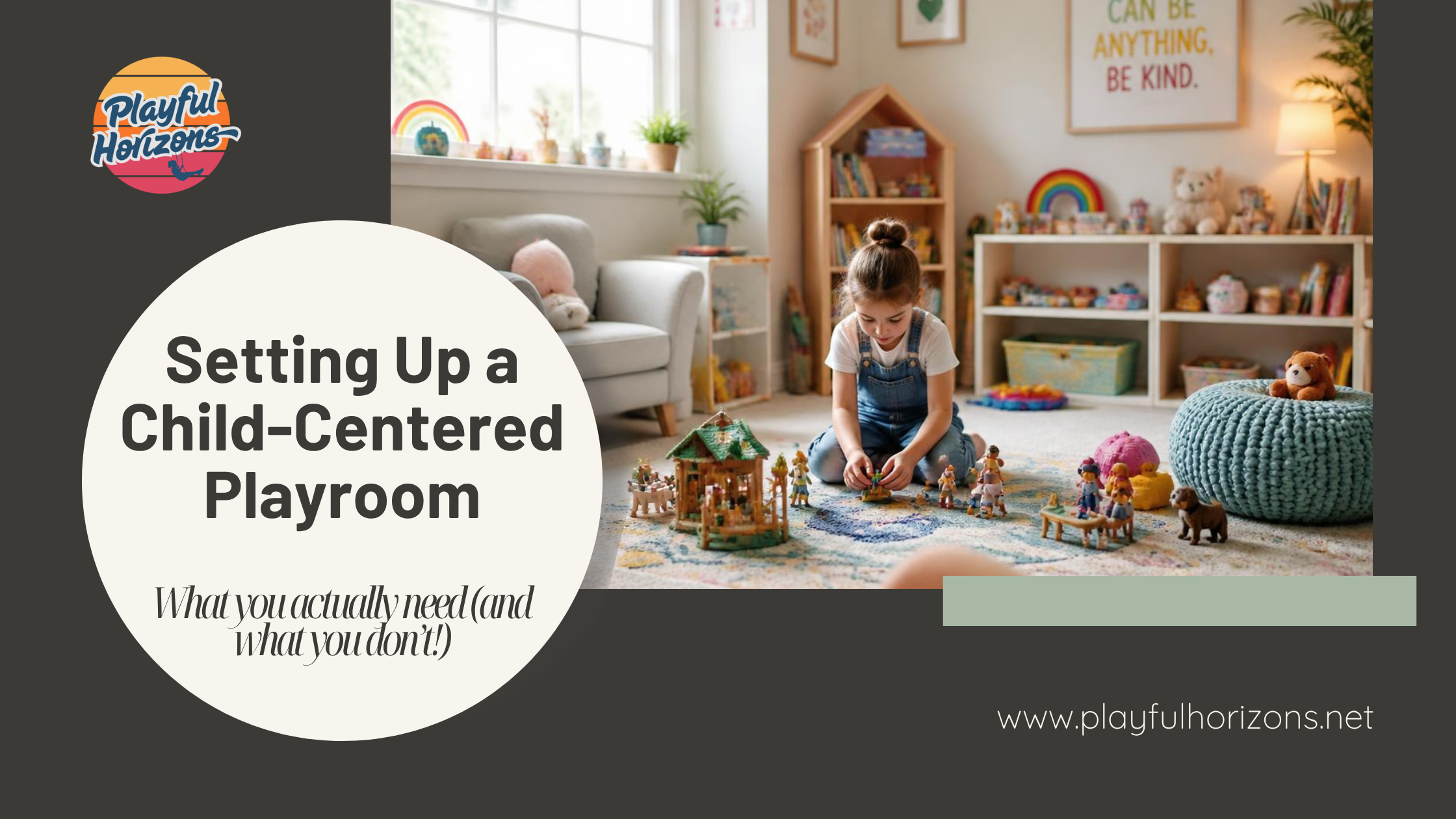
So let's talk about what actually belongs in a child-centered play therapy room, what doesn't, and how to think about building a space that a child can walk into and immediately feel: I'm safe here.
The Biggest Mistake New Therapists Make: Collect Instead of Select
I want to start here because I see this constantly, and it comes from a genuinely good place. Therapists are trying to do right by their clients. They take donations. They hit every garage sale. They fill bins with anything that might be useful. The thinking is that more options means more possibilities for the child.
But a play therapy room is not a toy store. And it's not a donation bin.
Every single item in a well-designed play therapy room should be there for a reason. A clinical reason. The room is carefully crafted to allow children to feel safe, to explore, to test limits, to express what they cannot say in words, and to heal through research-informed, evidence-based materials and processes. That is a very different thing from having a bunch of toys for a kid to play with.
A cluttered, overwhelming room communicates chaos. A child whose nervous system is already activated does not need more stimulation when they walk through the door. They need to be able to take a breath.
Select, don't collect. It's one of the most important things I tell new therapists.
What the Room Is Actually For
Before we get into specific items, it helps to understand the framework we're building from. In child-centered play therapy, the room is designed to communicate something to the child the moment they enter: “This space belongs to you. In here you can decide. You are safe.”
That means everything is at the child's level. Everything is accessible without help from an adult. Everything is sturdy enough to actually be used and not just looked at.
The room is not designed for the therapist. It's not designed for the parent. The art on the walls, the height of the shelves, the way materials are organized … all of it is intentionally built around a child's eye level, a child's reach, a child's sense of what is manageable and inviting.
Garry Landreth describes the playroom as the child's world. I think about that a lot when I'm setting up or evaluating a space. Does this room feel like it was made for a child, or does it feel like an adult put some toys in a room?
The Toy Categories That Belong in a CCPT Room
Landreth's framework organizes toys into categories based on the therapeutic function they serve. You don't need every toy ever made. You need representation across these core categories.
Real Life and Nurturing Toys
This is where you'll find dollhouses, baby dolls, doll families, a toy kitchen, dishes, and similar items. These materials allow children to play out domestic scenes, caretaking, family dynamics, and relational experiences. For many children, this is where some of the most significant therapeutic work happens quietly, through play, without a single direct conversation about it.
A note on representation here: your doll family and your people figures should reflect the real diversity of the children who walk through your door. Different skin tones, different family configurations, different body types. A child should be able to find themselves in the room.
Aggressive and Expressive Release Toys
This category surprises some people. But children need safe, appropriate ways to express anger, frustration, power, and aggression and a play therapy room should provide that.
Think rubber knives and handcuffs (yes, really), a bop bag, toy soldiers, wild animal figures, an alligator or shark puppet. These items give children a safe way to express big feelings and powerful themes. When a child spends a whole session having the lion eat everything in sight, they're communicating something. The room should be equipped to hold that.
This is also why quality matters. A bop bag that tips over at the first punch, or rubber toys that break apart, undermines the child's experience of being able to express something real. Get the items that can hold up to what children actually bring.
Creative Arts and Expressive Materials
Paint, clay, paper, markers. These are staples. But this is also a category where therapists tend to over-accumulate, so let me be specific about what to prioritize.
You want art materials that are open-ended and process-focused. Not kits with specific outcomes, not crafts with templates. Watercolors, finger paint, air-dry clay, plain paper in a few sizes. These give children complete creative freedom, which is the therapeutic point.
Check your supplies regularly. Dried-up markers and cracked, unusable clay communicate neglect. The message a child receives when they reach for a marker that doesn't work is subtle but real: this space isn't maintained. You don't have to spend a fortune, but what's in the room should actually function.
Puppets
Puppets deserve their own category because they are one of the most therapeutically versatile tools in the room. But this is also where I most often see the overcollection problem.
You do not need 20 puppets. You need a thoughtful selection, maybe 6 to 10, that covers an emotional range: something gentle and safe, something fierce and powerful, something small and vulnerable, something clever, something nurturing. Variety in what they represent matters more than quantity.
And they need to have mouths that open. A puppet a child can give a voice to is a completely different clinical tool than a flat stuffed animal. [Link: The Best Puppets for Play Therapy and How to Use Them]
Sensory and Sand Tray Materials
A sand tray is not a luxury. For many therapists it becomes one of the most-used tools in the room. If space allows, a sand tray (or even a smaller sensory bin) gives children access to one of the most naturally regulating and projectively rich materials we have.
Beyond the tray itself, having a curated selection of sensory tools available (like a few tactile fidgets, something weighted, something textured, etc.) supports children who need sensory input to regulate before they can engage. [Link: The Best Sensory School and Office Supplies for Therapists]
What NOT to Include
This is the section people don't talk about enough, so I want to be direct.
• Anything with characters or branding on it. Branded toys limit the projective possibilities and anchor the child's play to someone else's narrative. They may also go out of fashion, represent something the child isn’t familiar with or allow to watch, or communicate that the room is for a certain age child. It’s better to have neutral, timeless pieces. Note: This is different from having characters in your sandtray collection. That is a whole different debate for another day!
• Anything that requires batteries. If a toy does the thing on its own, the child is just watching it. We want children to be the agents of their play, not observers of it. If you do choose to have something with batteries (there are always exceptions to every rule) then check it regularly to ensure it you don’t have to change batteries mid-session.
• Anything a child cannot use independently. If they need an adult's help to operate it, it doesn't belong.
• Cheap items that break under real use. I know budget is real, especially when you're starting out. But a toy that breaks the first time a child genuinely plays with it doesn't just cost you money to replace, it costs the room its sense of reliability. Source quality items secondhand from Facebook Marketplace or friends if you need to. Wood when possible. Things that feel like they were made to last.
• Donations you haven't evaluated. Accept them gratefully, then assess each item against your clinical framework before it goes on a shelf. If you can't identify a therapeutic reason for it being there, it probably isn't right for the room.
• More than the space can hold comfortably. A room that is too full sends a signal of overwhelm before the session even begins. Restraint is a design principle here, not a budget limitation.
A Word on Layout and Organization
Open, low shelving is almost always preferable to closed bins, at least for the primary play materials. When children can see what's available, they can make genuine choices. When things are in bins, they have to dig, which creates both chaos and a sense that things are hidden rather than offered.
Keep things consistent. The sand tray is always in the same spot. The art supplies are always in the same corner. The puppets always live on the same shelf. Predictability in the room layout is part of what makes the room feel safe. When children know where to find things it gives them a sense of control and safety from the moment they walk in.
The room should be easy to reset between sessions. If putting the room back together takes you more than a few minutes, something about the organization isn't working. That matters practically as you often have back-to-back sessions and limited time in between.
And everything, again, at the child's level. Not yours.
Budget Reality: Where to Splurge and Where to Save
Let's be honest about money for a second because I think the pressure to have a fully stocked room on a brand new therapist budget can lead to exactly the cheap-items-that-break problem I described above.
Splurge on your puppets, your sand tray (or a good quality bin equivalent), your bop bag, your baby dolls and doll house. These are the things that will be used hard and that need to hold up over years of actual use.
Save on paper, basic art supplies, blocks. These are the consumable or easily replaced items where quality doesn't carry the same clinical weight.
Source secondhand where it makes sense: wooden toys, dollhouses, and shelving are all great Facebook Marketplace finds. Avoid buying used art supplies, puppets that are torn or saggy, or anything that comes to you already broken.
A room with 30 well-chosen, high quality items will serve your clients better than a room with 200 things. Every time.
Get the Full Checklist
Everything covered in this post (the toy categories, the specific items within each, the organization principles, and common items to skip) is pulled together into a complete, printable Play Therapy Room Checklist you can grab for free.
It follows Landreth's CCPT framework and is designed to take you from "I have an empty room" to "I know exactly what I need and why" without the overwhelm of starting from scratch.
[Download the Free Play Therapy Room Checklist]
You might also enjoy:
• The Best Puppets for Play Therapy (and How to Use Them Clinically)
• The Best Sensory School and Office Supplies for Therapists
• How Play Therapy Helps Children with Anxiety
• Limit Setting in Play Therapy: How to Use the ACT Model
What's one thing in your play therapy room you're not sure belongs there? Drop it in the comments. I'd genuinely love to think through it with you.