
Tracking in Child-Centered Play Therapy: What It Is, What It Isn't, and What to Say
* Blog may contain some affiliate links. That means I may earn a small commission (at no extra cost to you) if you choose to buy through them. I only share items I love, trust, or use in my own play spaces.
Tracking sounds incredibly simple until you're sitting across from an actual child trying to figure out how many different ways a human being can say, "You're putting that there." That's usually where therapists new to CCPT arrive in supervision. They’re slightly confused, a little self-conscious, and wondering if they're doing it right. And the honest answer is that tracking is both simpler and more nuanced than it appears on paper.
What Is Tracking?
Tracking is exactly what it sounds like: you track what the child is doing by naming it out loud. Simply, neutrally, without interpretation or judgment.
"You're putting that in the corner."
"You picked the red one."
"You decided that one goes over there."
That's it. No hidden meaning, no therapist interpretation layered on top. You’re simply witnessing and naming what you see.
In child-centered play therapy, tracking is one of the core skills because it does something really important. It tells the child that you are paying attention. Not evaluating or redirecting or curious about why they’re doing what they’re doing. You’re just present, watching, and with them.
Why Do We Track?
Because presence without proof can be invisible to a child.
Children, especially those who have experienced unpredictability or hurt in relationships, are often hypervigilant to whether the adults around them are really paying attention. Tracking is how we make our presence felt without inserting our agenda into the space.
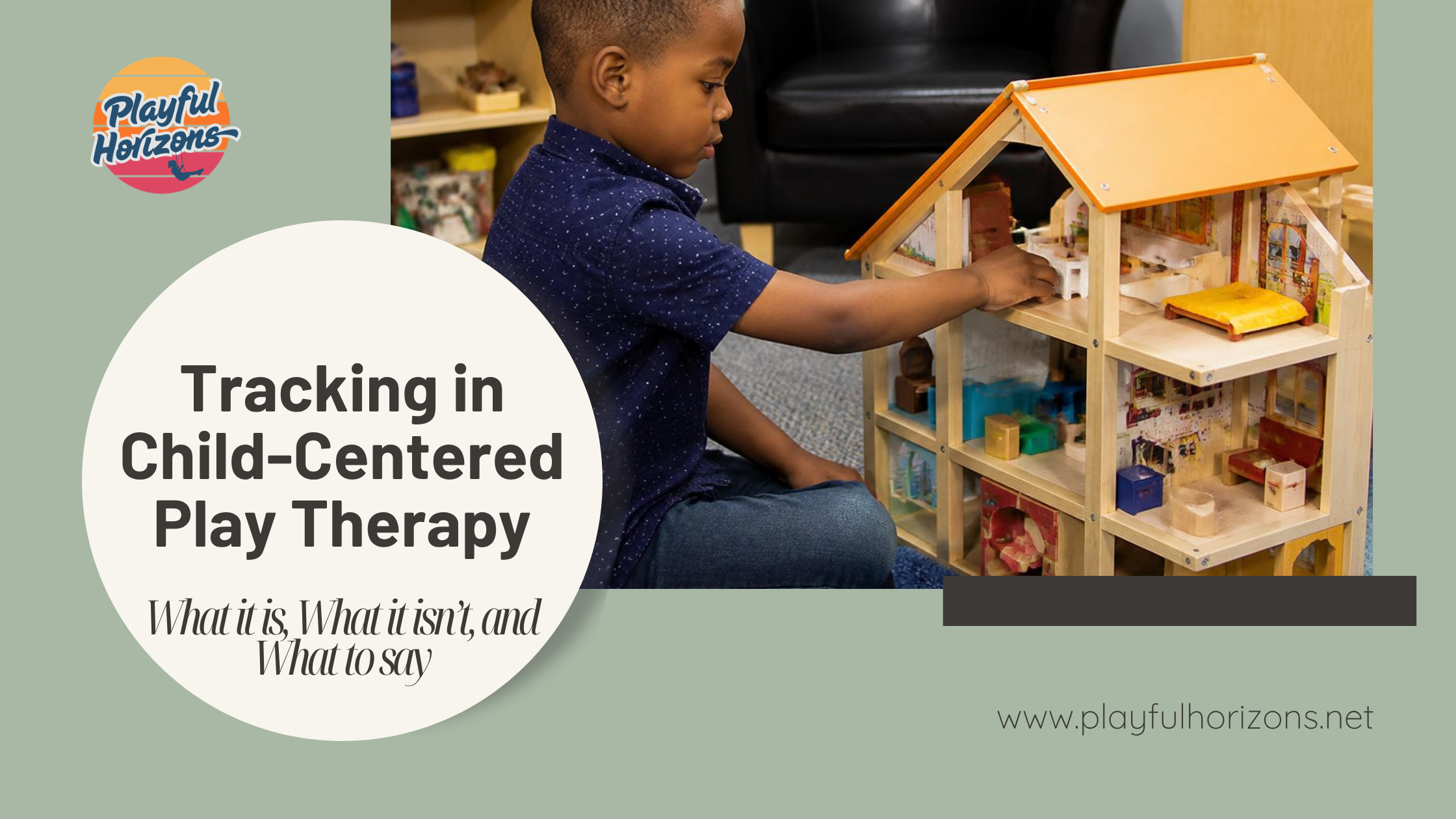
It also creates something powerful and underestimated … permission. When a child puts something unexpected in a dollhouse, something that doesn't quite belong in that room, and you simply say "you put that in the kitchen" without looking confused or asking why … the child gets to decide what to do with that. Whether to keep playing, to explain, to go deeper.
I had a moment like that once. A child was setting up a room in a dollhouse and placed something in there that you wouldn't typically expect. I just tracked it. Named what I saw and that was it. The child paused, glanced at me just slightly out of the side of their eye, and then started telling me something … not a lot, just a few sentences. Then they went right back to setting up the room.
That was it. That's the whole moment. But because of it, I got to see their play in a completely new context, and they got to share something that might have otherwise stayed completely hidden. The tracking didn't force anything. It just held the door open.
Tracking vs. Questioning
This is one of the most important distinctions in CCPT practice, and one of the easiest habits to slip into without realizing it.
Questions, even well-meaning ones, shift control of the session to the therapist. They redirect the child's attention, interrupt their process, and subtly suggest that the therapist's curiosity is more important than whatever the child was in the middle of doing.
Instead of this:
"Why did you put the dad over there?"
Try this:
"You decided Dad belongs way over here."
See the difference? The tracking statement acknowledges the child's choice with full acceptance. The question puts them on the spot. It asks them to explain and justify what might be deeply symbolic play that they themselves don't have words for yet. Tracking trusts that whatever the child is doing has meaning, even if neither of you can name it right now.
Tracking vs. Praising
Praise is tricky in CCPT because it feels kind and seems like it would be helpful to build rapport, but praise is evaluative. It tells the child that the therapist is judging their work, even positively, and that means the therapist's opinion matters, which means the child starts playing for the therapist rather than for themselves.
Instead of this:
"Good job building that tower!"
Try this:
"You worked really hard to get that exactly how you wanted it."
The tracking version still acknowledges the effort and the child's intention without putting a grade on it. It reflects back their experience rather than the therapist's assessment of their product and that’s the whole point. Allow the child to be the evaluator.
Tracking vs. Narrating Everything
Here's where I see new therapists often overcorrect. They hear "track what the child does" and they start narrating every single move like a sports commentator.
"You picked up the blue block. Now you're putting it on the red one. Now you're picking up the yellow one. You're putting that on top too. Now you're looking at the shelf…"
That's exhausting for everyone. It's also not really tracking … it's narrating, and it creates noise in the room rather than presence.
The most common mistake I see in supervision isn't bad tracking. It's tracking that isn't actually following the child's lead. Real tracking is responsive. It pays attention to how the child is responding and adjusts accordingly.
A few things to watch for:
• If the child seems engaged and regulated while you're tracking, keep going.
• If the child seems dysregulated by silence or keeps looking at you for reassurance, track more.
• If the child stops what they're doing every time you speak, or seems frustrated or distracted by your tracking, dial it back.
• If a child tells you directly "stop saying what I'm doing" or "you don't have to talk" … listen to them! You can stay present through non-verbal cues instead.
The amount you track should not be your personal preference or comfort level. It should be what that child actually needs in that moment. You can experiment a little, trying more or less, until you find a tempo that fits. When you follow the child's lead, you really can't go wrong.
When Silence Is Better Than Tracking
Sometimes the most attuned response is no words at all. I know silence is right when I feel a shift in the room. Not just a change in activity, but a shift in intensity. A child who was playing somewhat loosely suddenly becomes very focused or the energy in the room quietly rises. There's a quality to those moments that you start to recognize over time.
I might track that shift once ("you’re really working hard on that") and then follow the child into the quiet. Tracking the transition honors it, but continuing to track through it might interrupt it.
Silence is not the absence of presence. A regulated, attuned therapist sitting quietly with a child who is deep in their work is still communicating. Your body, your face, your calm … all of it tells the child you are there and sometimes that's more than enough.
What Tracking Actually Sounds Like
Sometimes it helps to just see a list of real examples so here are some tracking statements across different situations.
During construction or building play:
• "You're putting that one right on top."
• "You decided that one goes over here instead."
• "You're working on getting that exactly the way you want it."
During sand tray or dollhouse play:
• "You put her in that corner."
• "You decided that one stays outside."
• "You're moving everything around until it feels right."
During art or creative play:
• "You chose the darkest color for that part."
• "You're filling that whole section in."
• "You pressed really hard on that one."
Tracking behavior or expression the child didn't notice:
One of my favorite things to track is the unconscious expressions. I've tracked a stomp, a sudden exhale, a smile that crept in before the child could stop it and more than once the child has looked up surprised and said "oh, I didn't even know I was doing that" or "I didn't mean to stomp."
• "I noticed your shoulders just dropped a little."
• "You're smiling at that one."
• "Your foot stomped really hard just then."
The Deeper Point: Tracking Communicates More Than Presence
Tracking is sometimes described as a simple or even basic skill and the mechanics of it are simple, but what it's doing relationally is not small at all. When we track without interpreting, without evaluating, and without redirecting we're communicating something that a lot of children haven't reliably received from adults: “You can do whatever you need to do here, and I will not make it mean more or less than what it is to you. I will not grade it, explain it, or take it over. I will just see it.”
For children who have learned to monitor the reactions of adults constantly and to manage how they're perceived or to hide the parts that got them in trouble, that experience of being seen without being evaluated is genuinely rare. And genuinely therapeutic.
That's a lot to come from "you put that in the kitchen." But it does.
Want a Structured Way to Notice What's Actually Happening in Your Sessions?
Tracking in session is one thing. Tracking patterns across sessions is another and that's where a lot of the clinical picture really starts to emerge. Which toys does this child gravitate toward? How has the play shifted over time? What themes keep showing up?
The free Play Therapy Session Tracker and Clinical Reflection Sheet gives you a simple, structured way to capture that information without turning your session into a checklist. It's designed to be used right after session while things are still fresh. Just a few minutes of reflection builds your clinical picture over time.
[Download the free Play Therapy Session Tracker + Clinical Reflection Sheet]
You might also enjoy:
• Limit Setting in Play Therapy: How to Use the ACT Model
• Why Toy Selection Matters More Than You Think in Child-Centered Play Therapy
• How Play Therapy Helps Children with Anxiety
• The First 10 Toys Children Usually Choose (And What They Might Be Exploring)
What's your go-to tracking statement when you're just getting started in a session? Drop it in the comments. I'd love to build a bigger list with your help.