
The First 10 Toys Children Usually Choose (And What They Might Be Exploring)
Blog may contain some affiliate links. That means I may earn a small commission (at no extra cost to you) if you choose to buy through them. I only share items I love, trust, or use in my own play spaces.
Quick disclaimer before we get into this: play therapy is not a decoder ring. A child who picks up a sword is not automatically processing aggression. A child who heads for the baby doll is not automatically working through attachment.
What toys can do is open doors. They create invitations. And what a child does with a toy across time, in context, in relationship with you is where the meaning lives.
With that said, here are 10 toys children often reach for first, and the kinds of things they frequently open up.
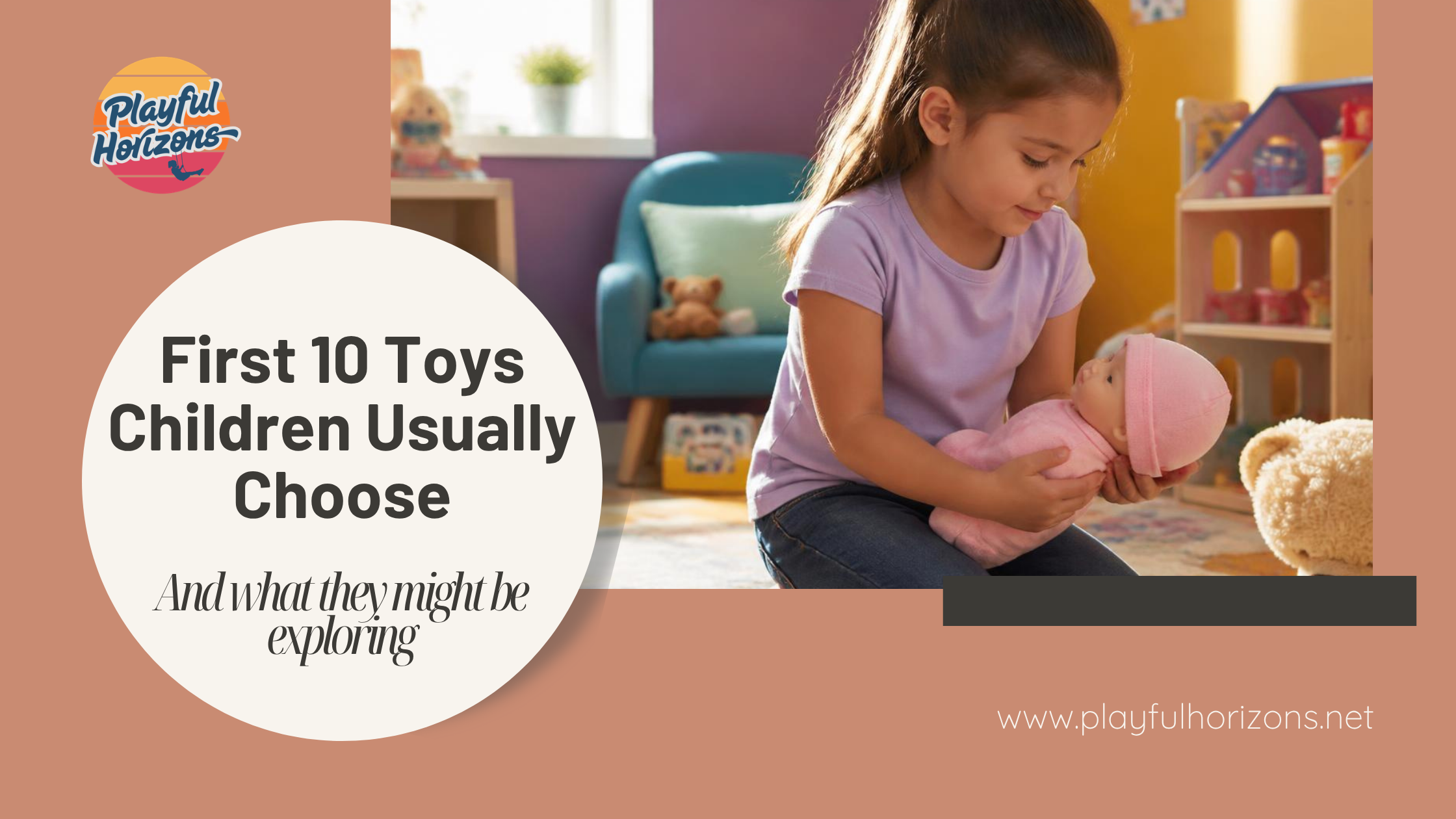
1. Baby Doll
Nurturing, caretaking, and relational play show up here a lot. A child rocking, feeding, or comforting a baby doll is often exploring what it feels like to be cared for, practicing care they wish they'd received, or both at the same time. It can also be about control in the gentlest sense … this baby needs me and I know exactly what to do. If you want a doll that holds up in session and comes in diverse skin tones, [Here’s a starter set I like].
2. Puppets
Puppets are one of the most versatile first-reach toys in the room, which is exactly why having a good selection matters. Some kids put one on immediately and start talking through it and the puppet becomes a vehicle for things they're not ready to say as themselves. Others will make two puppets interact, building a story that's not quite fiction and not quite their own life. The range of what puppets can hold is huge. We've written a whole post on this one. [The Best Puppets for Play Therapy]
3. Dollhouse
Here's the one that surprises new therapists the most: the dollhouse is not just for exploring family dynamics. Yes, family stuff shows up frequently and when it does, it can be incredibly rich. But a good dollhouse can become a school, a hospital, grandma's house, a friend's apartment, a military base, an alien planet.
This is why the type of dollhouse matters so much. A wooden one that's open on multiple sides, without overly specific interior decorating, lends itself to becoming anything. A child shouldn't have to work around a fixed pink kitchen to tell their story. [Click here for the dollhouse I put in EVERY play room I set-up]
4. Kitchen Set and Food
Real-life, domestic, nurturance. Kids who head for the kitchen are often exploring familiar roles like feeding, preparing, taking care of. Sometimes there's a parent or caregiver dynamic being played out. Sometimes it's just satisfying to do something that makes sense and has a clear purpose when not much else in life does. Either way, follow their lead on who's cooking for whom and why. [Click here for my kitchen and food recommendations]
5. Animal Figures
Which animals a child reaches for and how they use them tells you a lot. Wild predators used with intensity can open space for themes of danger, fear, or power. Farm animals arranged carefully might be about order, safety, or domesticity. Prehistoric creatures, always a hit, often bring in themes of bigness and strength. Some kids just love animals, and that's fine too. Let it be what it is and watch what develops. [A safari set I love]
6. Medical Kit
Developmentally, a lot of kids are genuinely just fascinated by the medical kit. They've been to the doctor, they know the instruments, they want to use them. Real-life role exploration, plain and simple. But it can also be about control (I'm the one with the tools now), nurturing (I'm going to take care of you), or processing something specific that happened in a medical context. Don't rush to interpret it. Just stay curious about who the patient is, who the doctor is, and what kind of care is being given. [This is the kit currently in my play room and portable kit]
7. Blocks
Building things, knocking them down, building them again. Mastery and control show up a lot here, but so does aggression. The satisfaction of a deliberate crash is real and clinically meaningful. Some kids build carefully and protect their structures. Some kids build specifically to destroy. Both are telling you something. Blocks are also one of the easiest entry points for parallel play with a quieter child who isn't ready to interact directly yet. [These are my favorite blocks]
8. Sword
Some kids go straight to the sword because it's different and they weren't expecting to see it. That element of surprise and permission is its own thing worth noticing. For others it opens space for power, protection, or aggression themes. Sometimes it's about testing limits: what happens when I have this? What will she do? All of that is information. The sword, like most things in the room, earns its meaning over time and in context, not in the first five minutes. [I like the variety in this set]
9. Handcuffs
The handcuffs are fascinating and honestly one of my favorites to watch. I once had a child on day one who wanted to put the handcuffs on me. Right away, first session. And I think that was about a few things at once like exploring what the limits were, checking what kind of person I was going to be, and maybe also telling me she wasn't quite ready to be fully in this yet. She needed to know she had some control over how much I could get close. Sometimes handcuffs are about power. Sometimes they're about safety. Sometimes they're about testing you. Pay attention to who is cuffing whom, and what happens next. [These are a good option]
10. Art Supplies
A child who goes straight to the art supplies on day one is often someone who knows what they need, something open-ended, something they can control completely, something with no right answer. Creating gives children a product that's entirely theirs. Watch what they make, how they make it, whether they show it to you or keep it private, and whether they want to take it home. All of it is communication. [Check out this list of supplies I love]
The most important thing to remember with any of these is that the toy is the invitation. You are the relationship. Both matter, and neither one does the work alone.
Which toy on this list have you found most surprising in terms of what it opens up? I'd love to hear it in the comments.
You might also enjoy:
• Why Toy Selection Matters More Than You Think in Child-Centered Play Therapy
• How to Set Up a Child-Centered Play Therapy Room: What You Actually Need
• The Best Puppets for Play Therapy (and How to Use Them Clinically)