
Why Toy Selection Matters More Than You Think in Child-Centered Play Therapy
Blog may contain some affiliate links. That means I may earn a small commission (at no extra cost to you) if you choose to buy through them. I only share items I love, trust, or use in my own play spaces.
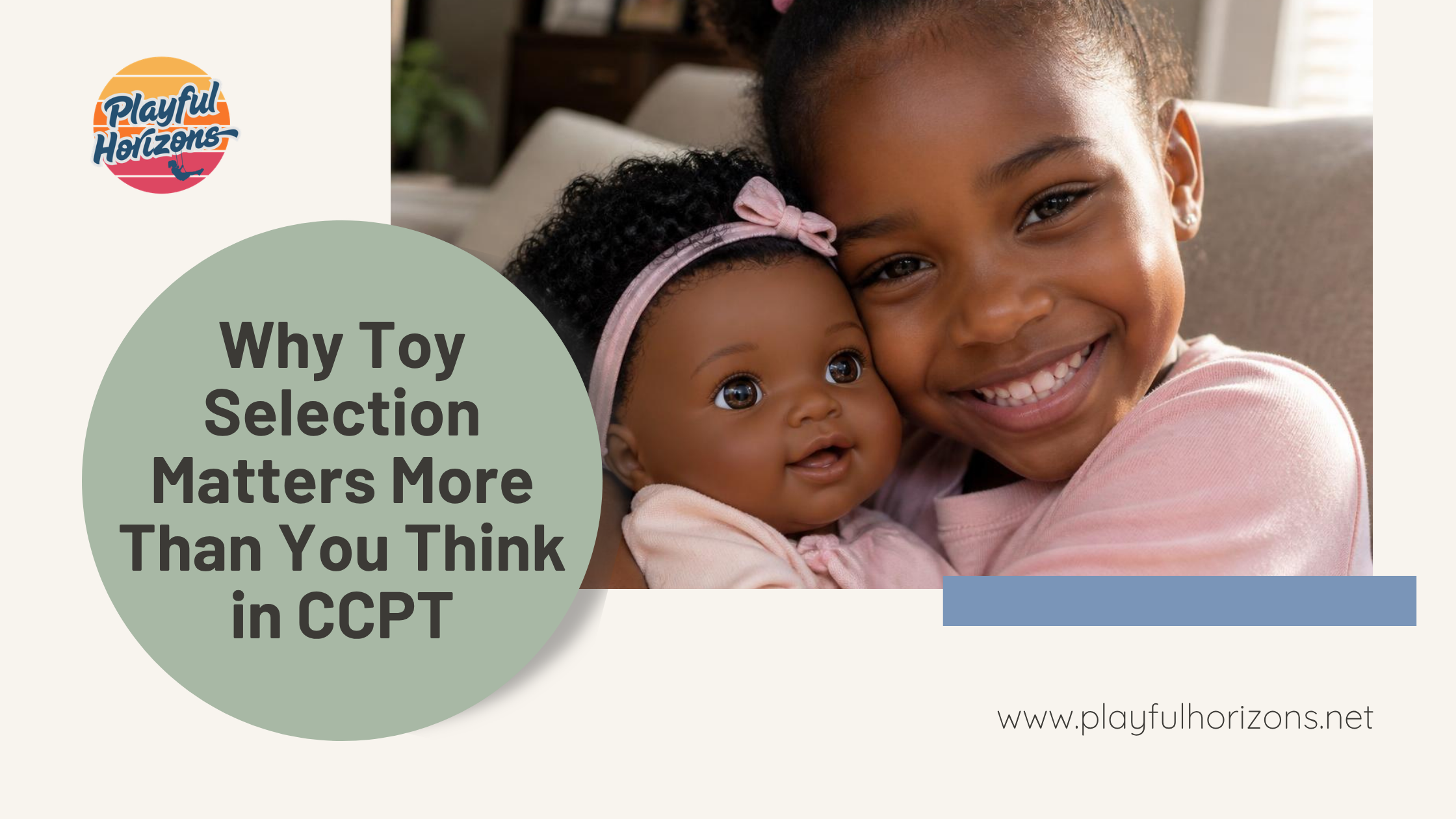
A little girl came into the play therapy room a bit shyly. She was looking around, taking it in, doing what kids do when they're still figuring out if a new space is safe. And then I watched her eyes land on the baby dolls.
She crossed the room in about three steps, picked up the one that had a similar skin tone and hair to hers, and her whole face changed. She smiled BIG and just started rocking that baby and comforting her like she'd been waiting for exactly that moment.
She didn't say anything about it. She didn't need to.
The room had already said something to her.
Toys Talk. Are Yours Saying the Right Things?
This is the thing I want every play therapist to really sit with: the toys in your room are communicating with your clients before you ever open your mouth. Before the session starts. Before you've built any rapport. Before you've said a single warm, reflective thing.
They're communicating acceptance. Or they're communicating that certain parts of who a child is weren't quite considered when the room was put together.
I've watched children scan sand tray shelves carefully, looking for a figure that looks like them or someone in their family, and come up short. They usually find something close and say "well, this isn't quite right, but you get the idea" and then they move on, because what else are they going to do? But there's a moment before that. A quiet resignation. A small adjustment to expectations that shouldn't have to happen in a therapy room.
Toys are not neutral objects. In a play therapy room they are clinical tools, and like any clinical tool, they either serve the child or they don't.
The Philosophy Behind the Toys: Landreth's Framework
Garry Landreth, whose work is the foundation of child-centered play therapy, is pretty clear about this. Toys are selected, not collected. The room is built with intention, and every item in it has a clinical reason for being there.
His philosophy starts from the belief that play is the natural language of children. Not a distraction, not a warm-up, not something we do until they're ready to "really" talk. Play is the therapeutic medium. Which means the materials we provide for that play are doing clinical work every time a child is in the room.
There's a line that I keep coming back to in this work: "If you focus on the problem, you lose sight of the child." That's the heart of CCPT for me. We're not here to fix a specific presenting concern. We're here to create the conditions (the safety, the relationship, the right environment) within which a child can do what they need to do. The problems tend to resolve as a byproduct of that.
The toys are part of how we build those conditions.
Why Categories Matter More Than Individual Items
One of the things that shifts for therapists when they really internalize Landreth's framework is that they stop thinking about toys as individual items and start thinking in categories. The question isn't "should I have this specific puppet?” It's "does my room have something that allows a child to express power, something that allows them to nurture, something that lets them create, something that lets them release aggression safely?"
The categories are doing the therapeutic work. The specific items within them have some flexibility.
Here's why this matters practically … a child who comes in carrying a lot of anger needs to find something in that room that says "your anger is welcome here." Not in those words. Just by being there. The bop bag. The rubber knife. The wild animal figures. The alligator puppet with the wide-open mouth.
I had a kid once who had been referred specifically for anger management. He walked in, saw the bop bag, and immediately looked at me and said "wait, am I actually allowed to punch that?" And the way he asked it told me everything. He'd been carrying the message that his anger was a problem, something to be managed and controlled and kept quiet. The room said something different to him in that moment.
That's what a well-chosen toy category does. It gives the child permission before you've said a word.
The Categories at a Glance
For those newer to the CCPT framework, Landreth organizes the play therapy room around several core categories. I've written about these in more depth in the room setup post, but here's the short version of what each category is doing therapeutically:
• Real life and nurturing toys (dollhouses, baby dolls, kitchen items) - allow children to process relational experiences, caretaking, family dynamics, and attachment themes through symbolic play.
• Aggressive expression toys (bop bag, rubber weapons, wild animals, predator puppets) - give children a safe, sanctioned outlet for anger, fear, and power themes that might otherwise have nowhere to go.
• Creative arts materials (paint, clay, plain paper) - open-ended, process-focused expression with no right answer and no way to fail.
• Puppets - projective distance, storytelling, and voicing what can't yet be said directly. [Link: The Best Puppets for Play Therapy]
• Sand tray and sensory materials - grounding, projection, world-building, and somatic regulation.
Representation Is a Clinical Issue, Not a Bonus Feature
I want to come back to the little girl and the baby doll for a second, because I think it illustrates something that doesn't get talked about directly enough.
Representation in the play therapy room isn't a nice-to-have. It's clinical. When a child can find themselves, their skin tone, their hair texture, their family configuration, their cultural markers, in the materials we've provided, they receive a message: “You were thought of. You belong here. This room was made for someone like you.”
When they can't find themselves, the message is quieter but just as real. And in a space that's supposed to be about safety and acceptance, that gap matters.
This applies to your doll families, your sand tray figures, your people puppets. Skin tones across a range. Different family configurations. Figures with different body types and abilities. Not a token effort, but a genuine attempt to make sure that when a child looks around this room, they can find themselves in it.
It also applies to the stories the room can hold. A room full of only gentle, nurturing figures cannot hold the stories of children who have experienced real threat and real fear. A room full of only aggressive or powerful figures cannot hold the stories of children who need softness and safety. The range matters.
Therapeutic Meaning vs. Random Accumulation
Here's a practical question worth asking about every single item in your room … Why is this here?
Not "it seemed like a good idea" or "someone donated it" or "kids like it." A clinical reason. What therapeutic function does this item serve? What category does it belong to? What does it allow a child to express or experience that they might not be able to otherwise?
If you can answer that question, the item earns its place. If you can't, it might just be clutter and clutter in a play therapy room isn't neutral. It's noise. It competes for the child's attention and muddies the clarity of the space.
This is a harder standard to apply than it sounds, especially when you're building a room on a budget and someone offers you a bag of toys. But it's worth it. A room with 40 intentional items is a more powerful therapeutic space than a room with 200 random ones.
Select. Don't collect.
A Note on Simplicity
One last thing, and it ties back to where I always land with this: an overcomplicated room gets in the way of the most important thing happening in that space, which is the relationship.
The toys matter. The categories matter. Representation matters enormously. But none of it replaces the therapist's presence, warmth, consistency, and genuine attunement to the child in front of them. CCPT is pretty clear that the relationship is the therapy. The room and the toys create the conditions for that relationship to do its work.
When the room is too full, too busy, too stimulating then that relationship is harder to feel. The room should settle the child, not activate them. It should communicate that this is a calm place. A safe place. A place where you have everything you need and nothing is asking too much of you.
Get the environment right, and then focus on the child. That's the work.
If You Want to Go Deeper
Garry Landreth's Play Therapy: The Art of the Relationship is genuinely the place to start if you want to understand the full philosophy behind CCPT toy selection. I've recommended it more times than I can count. It's the foundational text for this work and the thinking behind everything in this post.
[Shop Play Therapy: The Art of the Relationship on Amazon]
Some links may be affiliate links. I may earn a small commission at no extra cost to you.
You might also enjoy:
• How to Set Up a Child-Centered Play Therapy Room: What You Actually Need
• The Best Puppets for Play Therapy (and How to Use Them Clinically)
• Limit Setting in Play Therapy: How to Use the ACT Model
• How Play Therapy Helps Children with Anxiety
Is there a toy or category in your room that you're not sure is earning its place? I'd love to think through it with you in the comments.