
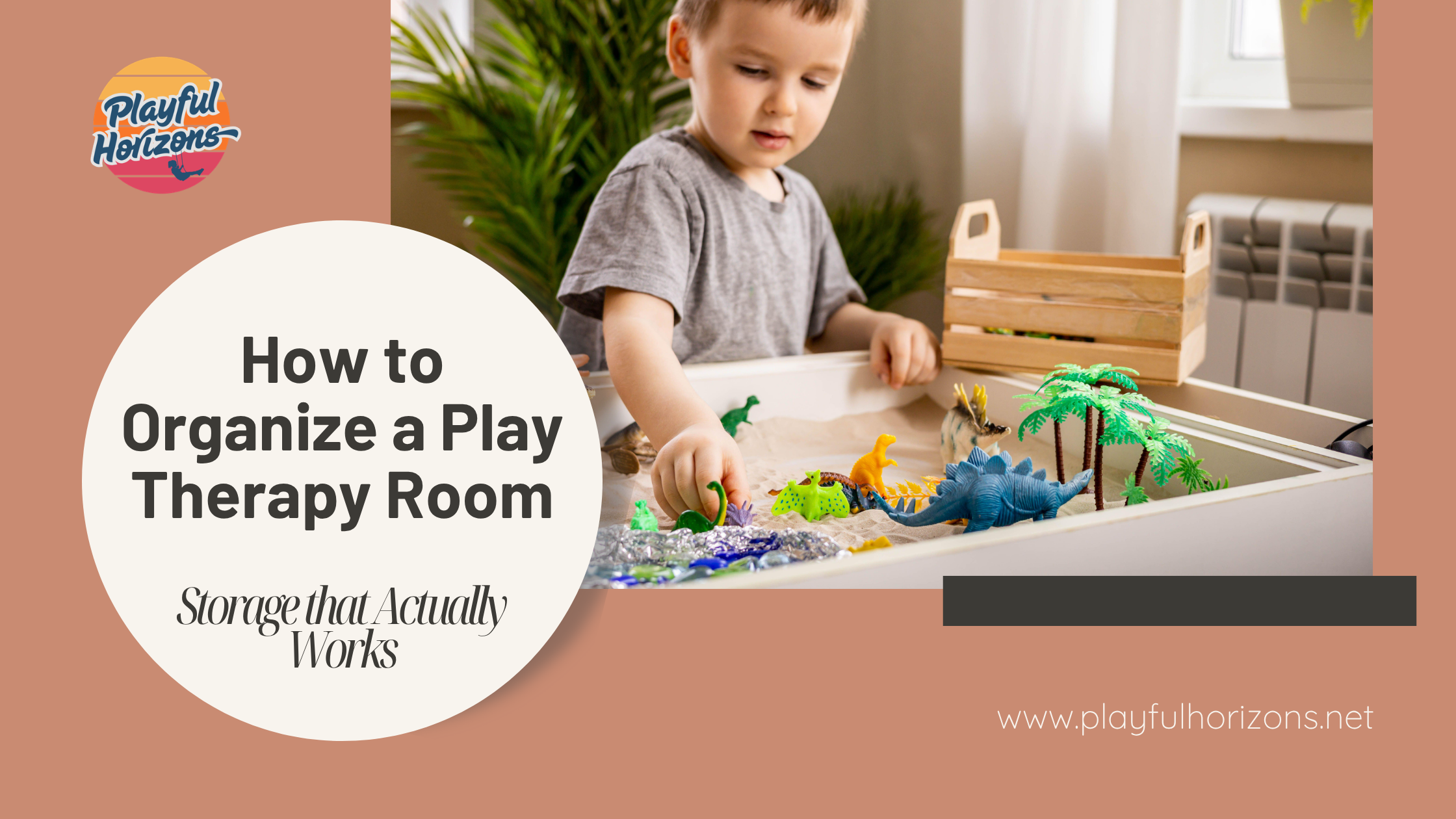
How to Organize a Play Therapy Room: Storage That Actually Works
* Blog may contain some affiliate links. That means I may earn a small commission (at no extra cost to you) if you choose to buy through them. I only share items I love, trust, or use in my own play spaces.
I love scrolling through beautifully organized play therapy rooms that look incredible on Instagram or Pinterest, but the truth is most of those rooms are kind of awful for children to actually use.
Everything in matching containers with labels on every basket, and toys tucked behind closed doors or inside lidded bins where nobody can see what’s actually inside. The room looks calm and beautiful ... and then a child walks in and can't figure out where anything is, can't reach half of it, and has to ask the therapist for permission to access every single thing. That's not a therapeutic space. That's a showroom that can actually hinder the child’s work.
Good play therapy room organization starts with one question: can the child see what's available and access it independently? Everything else builds from there.
Start with Visibility, Not Aesthetics
The clinical principle behind open, visible storage is the same one that drives everything else in a well-designed play therapy room: the child should be in the lead. A child can't lead if they don't know what they have to work with. Materials that are visible communicate that they are all available to use. Materials that are hidden communicate that you have to ask.
Beyond visibility, a few things matter enormously:
• Child height. If a child has to stand on their toes or ask you to reach something, the room is organized for the adults, not the child.
• Predictable location. Materials should live in the same place every session. Consistency in the environment is part of what makes the room feel safe.
• Easy reset. We often have back-to-back sessions with very little time in between. A system that takes twenty minutes to put back together after a session with a three-year-old is not a sustainable system.
I also want to say something about room energy, because it matters more than people acknowledge. When everything is visible and accessible, the room feels inviting and light. When things are tucked away behind doors and bins, the room can start to feel heavy, guarded, and a little anxious. That feeling is communicated to the child before they've touched a single thing.
Open Shelving: The Foundation of a Good System
If I could recommend one thing to every therapist setting up or reorganizing a play therapy room, it would be low, open shelving in a light color.
My personal favorite is the IKEA BILLY bookcase, specifically in white. I know that's a very specific recommendation but here's why I keep coming back to it: the shelves are adjustable and easy to move, it's not expensive, it's easy to put together, and the white keeps the room feeling airy and open so the toys become the most interesting thing in the space rather than the furniture. The neutral backdrop lets everything on the shelf show up clearly. And it wipes down easily, which matters when you work with children.
Whatever shelving you choose, look for:
• Low enough for children to see and reach the top shelf without help
• Open fronts: no doors, no baskets that hide what's inside
• Sturdy enough to withstand years of use without wobbling
• Light in color to keep the room feeling open rather than heavy
Cube shelves and low bookshelves also work beautifully. [Like THIS or THIS]
Clear Bins: The Unsung Hero of Play Room Storage
Here's something I've learned the hard way, especially when working with younger children or running back-to-back sessions: even though open shelving with miniatures standing up is ideal, it can be a real nightmare to reset between sessions when you have kids who knock down every single miniature or pull out every single block. (I can just see that kiddo slowly raking his hand across the miniature shelves as I type!)
Clear bins solve this problem really well. They let you see what's inside without digging, they make cleanup faster (everything for that category goes back in the same bin), and children can still identify and access what they're looking for without help. I keep larger signature items on the shelves, like the dollhouse and the baby dolls, and then use clear bins for the smaller-category items:
• All blocks in one bin
• Doll accessories in another
• Play food in its own
• Each sand tray category in it’s own (a bin for people, a bin for furniture, etc.)
The key is keeping each category separate so the child can still find what they're looking for and the bins are clear enough to see inside without dumping. Avoid bins that are too deep, if a child has to dig to the bottom to find something, the bin is working against you.
A giant opaque toy chest is the opposite of what we want. Everything mixed together, nothing visible, nothing accessible without climbing in or dumping the whole thing. It might look tidy. It's clinically counterproductive. [Try these clear bins]
Rolling Carts: A Game Changer for Small or Shared Spaces
Rolling carts are one of the most underrated storage solutions in a therapy room and an absolute necessity if you work in a small room, a shared space, or you do any school-based work.
A rolling cart with bins or tiers gives every supply category a home. It goes where you go. It can be tucked into a corner when you need floor space and pulled out during session. And for therapists who move between rooms or offices, it means your supplies travel with you in an organized way rather than in a bag of chaos.
Rolling carts work especially well for:
• Art supplies and sensory materials
• Smaller fidgets and regulation tools
• Backup supplies you want accessible but not on the main shelves
• School counselor offices where space is at a premium
The RASKOG cart from IKEA is a popular option and genuinely earns the praise it gets. [Try this similar version]
Art Supply Storage: Organized, Visible, and Ready to Use
Art supplies deserve their own section because they have their own unique organization challenges with lots of small items, things that dry out or break and need replacing, and a range of sizes from paper to tiny markers to large clay blocks.
My absolute favorite art supply storage is the IKEA SKADIS pegboard system. I know recommending two IKEA products in one post might make me sound like I have a sponsorship with IKEA (I don't, but I’d definitely be down if they ever reach out!), but these genuinely work. The SKADIS boards with all their accessories (small shelves, buckets, clips, etc) create a system where every art supply has a home, everything is visible, and the whole setup looks incredibly satisfying. There are so many accessories in the line that you can build exactly the configuration that works for your space.
Whatever system you use, the goals for art supply storage are:
• Easy access without having to open anything or dig
• Visible enough that a child can see what's available at a glance
• A clear system for knowing when something needs to be replaced (dried markers, used-up paper, hardened Play-Doh)
• Enough separation that a child can choose one type of art material without everything else coming with it
Clear buckets and small open containers work especially well here … you can see at a glance whether the markers are full, whether the paper supply is running low, whether the clay has dried out, etc. [Try this system that’s similar to the SKADIS]
Sandtray Miniature Storage
Miniature storage has its own logic because the goal is to make every figure visible and accessible while still maintaining enough organization that both the therapist and the child can find things by category.
Ideally, miniatures live on shallow open shelving where figures can stand upright and be seen clearly. Wall shelves work beautifully for this as they don't take up floor space and they display figures like an art installation rather than a storage solution. Grouping by category (people here, animals here, buildings here) gives the collection structure without making it rigid.
For the practical reality of working with younger children and back-to-back sessions, clear bins by category are a completely reasonable solution especially for smaller figures that are easy to knock over. All animals in one clear bin, all transportation in another. It's not as visually beautiful as standing figures on open shelves, but it's sustainable, and a sustainable system is better than a perfect one you abandon after three weeks.
For a full breakdown of what actually belongs in a sandtray miniature collection and how to build one with real symbolic range check out my previous blog: Best Sand Tray Miniatures for Play Therapy: What You Actually Need.
Dollhouses and Larger Items
The dollhouse, the sandtray, the bop bag, the play kitchen, etc are signature items that should be accessible and visible, not tucked in corners or behind other things.
The dollhouse should be positioned so a child can approach it from multiple sides if possible, which is another reason the open-sided wooden dollhouse works so well because it invites engagement from different angles rather than just the front.
The temptation with larger items is to put them in a bin or closet "to keep things tidy." Resist this. A dollhouse in a cabinet is a dollhouse that children don't reach for. These are your anchor items and the ones children return to most. They earn their floor space.
Aggressive-Release Toys
The bop bag, foam noodles, handcuffs, and rubber weapons need to be stored in a way that is visible and accessible without feeling like they're being presented as the main event.
The bop bag lives on the floor, inflated and ready. Foam noodles can stand upright in a tall bin or a corner. Rubber weapons can sit on a low shelf alongside other play items rather than hidden away. The same principle applies here as everywhere else: if the child has to ask for access, the item's therapeutic value is already compromised.
Storing these items in a separate locked cabinet or out of sight sends its own message … that this content is not really welcome in the room. The whole point of having them is that they're available. Keep them that way.
What I Would NOT Do
This is the section I want to be really direct about, because some of these are common and none of them serve children well.
• Lock every toy away. If a child has to wait for you to get or open something then room is not built for them. Safety locks on certain items are sometimes necessary, but making the default access method a key or a latch changes the entire relational dynamic of the room.
• Use a giant toy chest. Everything mixed together, nothing visible, nothing findable without dumping the whole thing. It might look clean, but it's not functional.
• Rotate the room so frequently that the environment becomes unpredictable. Rotating materials occasionally is fine. Changing everything around so often that a child never knows where to find things undermines the sense of safety and predictability that is core to what we're building.
• Overload shelves until nothing is visually accessible. When shelves are packed so tightly that everything blurs together, the room is overwhelming before a child has moved a single thing. White space on a shelf is not wasted space … it's breathing room.
• Let your own anxiety about mess drive the organization system. If you feel anxious every time a child takes something out or leaves it on the floor the system is not working. A good organization system should be easy enough to reset that the therapist can stay regulated during and after a session.
Organization in Tiny or Shared Spaces
School counselors and school-based therapists often don't have the luxury of a dedicated room that stays set up between sessions. If that's your situation, the same principles apply, you just have to work with a more compact system.
• A rolling cart becomes your room. Everything organized by drawer, everything moveable.
• A few clear bins that can stack and travel cover your core supply categories.
• A portable sandtray with a small selection of miniatures in a divided container gives you sandtray capability without a permanent setup.
• A small open bin or tote that sets up quickly on a table gives children immediate visible access to what's available.
The full portable play therapy kit guide, including specific supply recommendations for therapists who move between spaces, is here: Ultimate Portable Play Therapy Supply Lists
My Recommended Starter Storage System
If I were setting up a play therapy room today from scratch, here's what I'd build toward:
• Low, open shelving in white (the BILLY bookcase is my personal go-to) along the main wall. This becomes the home for your anchor items like the dollhouse, animal figures, puppets, building materials.
• One rolling cart OR peg board with accessories for art supplies, sensory tools, and smaller supplies that need to be accessible but don't live on the main shelves.
• Clear bins by category placed on or below the main shelves for smaller items like blocks, doll accessories, play food, and art supply overflow.
• Dedicated sandtray shelving (shallow wall shelves or a section of the main bookcase) for miniatures, organized by category.
•One supply cabinet for backup materials like extra paper, replacement markers, extra Play-Doh that the therapist accesses, not the child. Ideally this would be outside of the play room, but something mounted up higher or tucked away could work if needed.
Ready to Go Deeper?
Organization is only one piece of a well-designed play therapy room. If you're setting up from scratch or rethinking what belongs in your space at all:
Read: How to Set Up a Child-Centered Play Therapy Room: What You Actually Need
And if you want a comprehensive, research-based checklist to make sure you've covered all the right categories:
Download the Free Play Therapy Room Checklist
You might also enjoy:
• Why Toy Selection Matters More Than You Think in Child-Centered Play Therapy
• Best Sand Tray Miniatures for Play Therapy: What You Actually Need
• Back-to-School Therapy Office Essentials
• Ultimate Portable Play Therapy Supply Lists
What's the storage solution in your therapy room that you love or the one you wish you'd done differently? Drop it in the comments.